
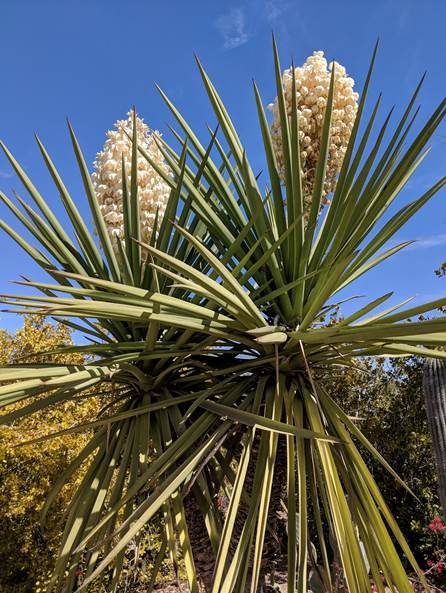
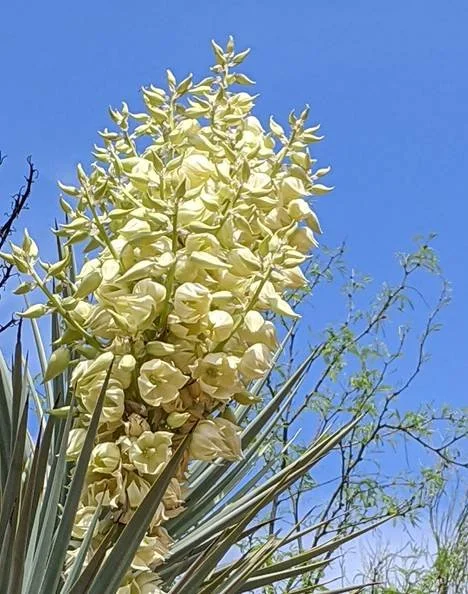
Yucca, in full bloom in the spring
Uses
Anti-inflammatory with saponins, while demulcent and vulnerary
1st choice for easing the pain, excoriation and tissue damage caused by passing a kidney stone
1st choice for Giardia infections
Top five for the joint pain of osteoarthritis, rheumatoid arthritis and gout
For Kidney Stones
Yucca species, such as Yucca elata, are among the most important herbs in our emergency medicinary for a kidney stone passing through a ureter. For this purpose, we combine a tincture of the root with five other herbs, learned from herbalist David Winston:
Yucca, Hydrangea, Aesculus, Piper methysticum, Ammi visnaga, Lobelia. That’s 4 parts for each of the first two herbs, two parts for each of the next two herbs, and only a small splash of the last two into the 4-ounce bottle of combined alcohol-extract tincture. The Yucca portion is a 1:4 mix of Yucca root extract in distilled water and / or distilled alcohol. Lobelia is quite potent, and must be used carefully and sparingly, because it can provoke nausea in too high a dose. We put a maximum of 2 ml Lobelia in a 4-ounce bottle with the other herbs listed. Winston describes Lobelia as “a phenomenal anti-spasmodic.”
For the emergency pain of passing a kidney stone, we dose this at one teaspoonful every half hour. Traditionally, it is often given with beer, which is known to relax smooth muscle throughout the urinary tract. (This is the only recommendation our clinic makes for beer at any time; the extreme pain of passing a kidney stone of any type warrants this measure to facilitate passing the stone.)
This herbal tincture does not conflict with any emergency care, such as lithotripsy or painkillers. However, beer or other alcohol does conflict with pain medication, and must be stopped if the latter are taken.
If the patient is not in pain, but there is a known kidney stone, dissolving strategies are often used, such as 1/8 teaspoon per day of potassium citrate in water and separately after a meal, ¼ teaspoon of baking soda, which is sodium bicarbonate. For uric acid stones, we rely on lemon juice in water taken two or three times per day, with follow-up ultrasound at 3 months to make sure the stone is shrinking or gone.
Giardia protozoa infection
For Giardia infections, very dilute Yucca, 22 micrograms / ml in animal studies reduced Giardia trophozoites comparably to the antibiotic metronidazole.[1] Clinically, we dose this at a much higher concentration for active Giardia generally at 2 ml of a 1:4 extract in distilled water and / or distilled alcohol two times daily for three weeks.
Please note that symptoms of Giardia infection resemble other IBS and celiac sprue or general gluten intolerance. Often Giardia infections are missed this way. One way for the clinician to help differentiate the diagnosis is to ask the patient, “Have you been camping or traveling in remote areas recently?” Giardia is a common microbe in rivers, creeks, lakes and shallow wells.
Yucca added to cattle feed and poultry feed have reduced odor and ammonia emissions significantly, and are widely used by ranchers for this purpose. This is due to the saponin effect against protozoa such as Giardia,[2] as discussed below.
Pharmacology and Mechanisms of Action
Saponins and resveratrol flavonoids are the most studied categories of phytochemicals in Yucca. While the effects are different, the anti-protozoa effects of the first type along with the anti-oxidant and anti-inflammatory effects of the second type, combine to make a useful therapy for patients with rheumatic illnesses and inflammation. Yucca has been used successfully for this category of pathologies of the joints of the kidneys and of the GI tract.
Sarsaponins in Yucca species work against Giardia and other protozoa, because the saponins in the plant disrupt the sterol molecules in the cell membranes of the protozoa, especially in the ciliate protozoa, such as Giardia.[3] Ruminants given these Yucca-derived sarsaponins had the added benefit of decline in methane production.[4][5]
The effect of saponins against kidney stones has preventive value in that these molecules inhibit formation and aggregation of calcium oxalate crystals. Yucca’s saponins and demulcent property have the added benefits of protecting renal cells from damage by sharp oxalate crystals. The soapy texture of saponins also reduce the stickiness of kidney stones adhering to the urinary tract,[6] and eases their passage, as well as acting as a diuretic, to help flush stones out.[7]
Side Effects and Contraindications
None known, when eaten as a root vegetable in moderation.
Native Origin and Range
Yucca is native to desert land in the southwestern United States and Mexico. Yucca shows its membership in the Agave family Agavaceae by its spiky leaves similar to other agaves of the same region.
Please note that Yucca in the Agave family is completely different than yuca, also known as cassava, manioc or tapioca, which is a tropical plant in the spurge family.
-
A McAllister, C Annett, et al. Studies on the use of Yucca schidigera to control giardosis. May 22 2001. Vet Parsitol. 97 (21). 85-89. https://www.sciencedirect.com/science/article/abs/pii/S0304401701003946
C Stumm, H Gijzen, et al. Association of methanogenic bacteria with ovine rumen ciliates. Jan 1982. Br J Nutr. 47 (1). 95-99. https://pubmed.ncbi.nlm.nih.gov/6800402/
R Wallace, L Arthaud, et al. Influence of Yucca schidigera extract on ruminal ammonia concentrations and ruminal microorganisms. Jun 1994. Appl Environ Microbiol. 60 (6). 1762-1767. https://journals.asm.org/doi/epdf/10.1128/aem.60.6.1762-1767.1994
Z Lila, N Mohammed, et al. Effect of sarsaponin on ruminal fermentation with particular reference to methan production in vitro. October 2003. Journal of Dairy Science. 86 (10). 3330-3336. https://www.sciencedirect.com/science/article/pii/S0022030203739356#bib33
M Grobner, D Johnson, et al. Sarsaponin effects on in vitro continuous flow fermentation of a high grain diet. J Anim Sci. 55 (1982) 491-497. https://agris.fao.org/search/en/providers/123819/records/64735ea008fd68d5460332fa
P Patel, M Patel, et al. Antiurolithiatic activity of saponin rich fraction from the fruits of Solanum xanthocarpum Schrad. & Wendl. (Solanaceae) against ethylene glycol induced urolithiasis in rats. Oct 2012. J Ethnopharmacol. 144 (1). 160-170. https://pubmed.ncbi.nlm.nih.gov/22981722/
A Singh, V Chitra. A prove on the activity of herbal medicines in nephrology. Oct 2018. Res J Pharm and Tech. 12 (9). 4539-4544. DOI: 10.5958/0974-360X.2019.00781.9
