
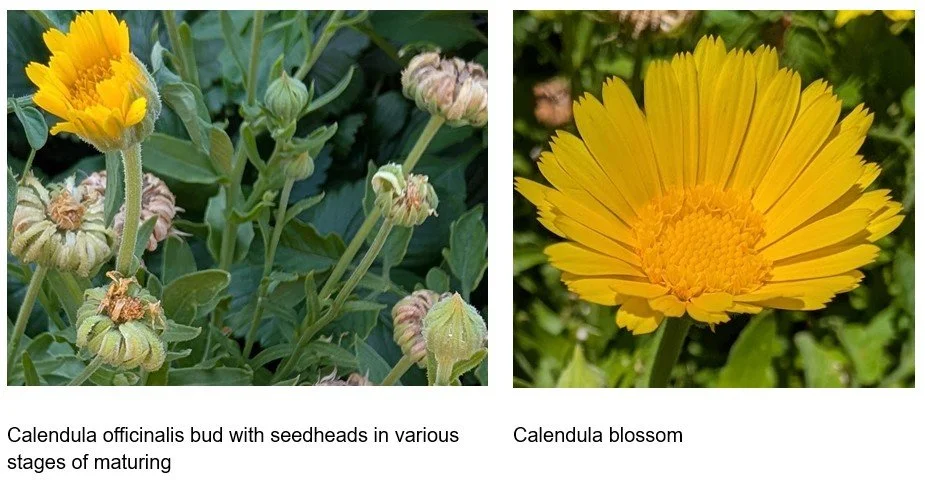
Calendula officinalis, flowers
Uses
Wound-healing, vulnerary
1st choice for healing external skin wounds, such as lacerations and abrasions and diabetic foot ulcers. [1]
1st choice, along with liquid vitamin A, for healing oral wounds
2nd choice, after aloe vera, or with aloe, for healing burns
Adjunct use orally in ulcers of the GI tract
Anti-microbial
Anti-inflammatory
Calendula grows throughout most of the world, and it is extraordinarily valuable across the ages of human history. Throughout the scrapes and hazards of rough encounters with nature faced by our distant ancestors, Calendula has the tremendous value of being anti-microbial and wound-healing.
In naturopathic medical school, we had two courses and multiple clinical rotations in minor surgery. As medical students, we removed moles, lipomas, sebaceous cysts, foreign objects, etc. mostly no deeper than the dermis. We then sutured the surgical incision and dressed the new wound with nothing other than oil made from Calendula flowers (in a base of organic, cold-pressed, extra-virgin olive oil).
None of the patients in our minor surgery rotations ever had a problem with infection, and the surgical site always healed beautifully.
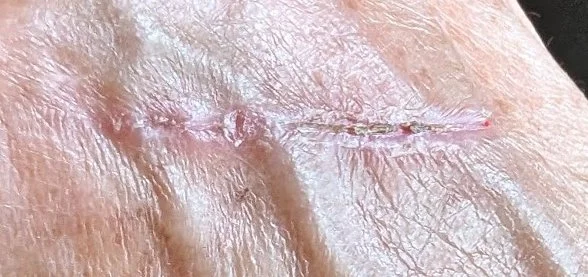
A 68 yo patient came in 8 days following an injury to the back of the hand. A picture frame had fallen onto her hand from about 3 feet height. Blood emerged from the whole length of a 5-centimeter laceration. The patient dressed the wound only with Calendula oil and covered it with a bandage during that week.
8 days following the injury, her hand now appears as follows, where the scabbed area is now less than one centimeter. The reader can appreciate where the injury was wider and longer than now appears, and where re-epithelialization has occurred, with only time and Calendula healing the wound.
In treatment of diabetic foot ulcers, healing is significantly faster with application of topical Calendula than with conventional treatments alone. [2]
Pharmacology and Mechanisms of Action
Calendula contains various types of terpene and triterpenoid phytochemicals that excel at anti-microbial effects. [3] Calendula extract has been shown to be both anti-bacterial and anti-fungal. [4]
Calendula flowers have high-molecular weight polysaccharides that are branched-chain heteroglycans, which are thought to activate the immune system. [5]
Wound healing is likely accomplished by glycoproteins, nucleoproteins and proto-collagen molecules leading to procollagen synthesis and fibroblast migration and proliferation. [6] These are the basis of tissue regeneration and faster epithelial tissue development seen with use of Calendula topical preparations. [7]
Side Effect and Contraindications
None known
Native Origin and Range
Calendula is native to the Mediterranean region. It now grows throughout Europe, Asia, Australia and the Americas, including in desert regions. It is highly adaptable, flowers in the spring, and is self-seeding in both sun and partial shade. Calendula survives in abandoned lots and roadsides, in USDA zones 2 through 11.
-
M Buzzi, F de Freitas, et al. A prospective, descriptive study to assess the clinical benefits of using Calendula officinalis hydroglycolic extract for the topical treatment of diabetic foot ulcers. Mar 2016. Ostomy Wound Mgt. . 62 (3) 8-24. https://pubmed.ncbi.nlm.nih.gov/26978856/
N Richmond, A Vivas, et al. Topical and biological therapies for diabetic foot ulcers. Sep 2013. Med Clin North America. 97 (5). 883-898. https://www.sciencedirect.com/science/article/abs/pii/S0025712513000552?via%3Dihub
D Arora, A Rani, et al. A review on phytochemistry and ethnopharmacological aspects of genus Calendula. Jul-Dec 2013. Pharcogn Rev. 7 (14). 179-187. https://pmc.ncbi.nlm.nih.gov/articles/PMC3841996/
E Efstratiou, A Hussain, et al. Antimicrobial activity of Calendula officinalis petal extracts against fungi, as well as Gram-negative and Gram-positive clinical pathogens. Aug 2012. Sci Dir: Compl Ther in Clin Prac 18 (3). https://www.sciencedirect.com/science/article/abs/pii/S1744388112000096?via%3Dihub
H Wagner, A Proksch, et al. [Immunostimulating action of polysaccharide (heteroglycans) from higher plants] art. In German. 1985. Arzneimittelforschung. 35 (7). 1069-75. https://pubmed.ncbi.nlm.nih.gov/4052142/
M Franza, B Heinzmann, et al. Determination of the wound healing effect of Calendula extracts using the scratch assay with 3T3 fibroblasts. Dec 10 2009. J Ethnopharmacol. 126 (3). 463-467. https://www.sciencedirect.com/science/article/abs/pii/S0378874109005741
E Kouchek-Popova, A Popov. Influence of the physiological regeneration and epithelialization using fractions isolated from Calendula officinalis. 1982, Acta Physiol. Pharmacol. Bulg. 8 (4). 63-67. https://pubmed.ncbi.nlm.nih.gov/7185264/
