
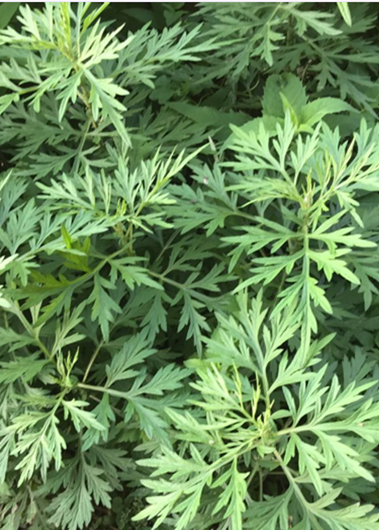
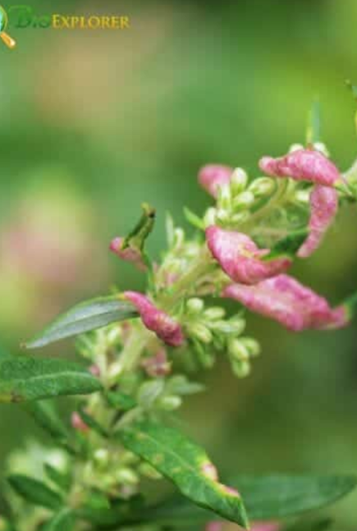
Mugwort images from https://plantsnap.com and https://www.bioexplorer.net respectively.
Artemisia vulgaris, commonly known as Mugwort; leaves and flowers
Uses
One of the top ten herbs for rheumatoid arthritis and gout, topically
Possible antidote to liver damage from seed oils and other peroxidation
Opium overdose (17th century use)
Diaphoretic and expectorant, as a hot tea
For gout, topical use
Early 19th century British herbalist and ambassador Robert John Thornton, MD suffered a disabling attack of gout in his foot. After weeks of ineffective treatments, he was convinced by a woman from India to allow her to burn a small cone that she made of the compressed leaves of Mugwort on his foot at the epicenter of his pain. He describes the experience as follows:¹
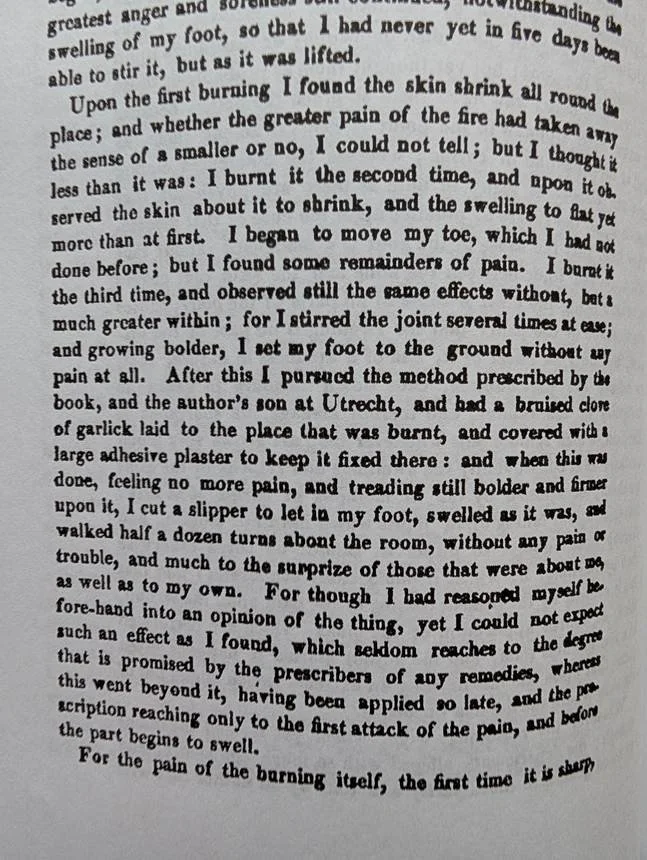
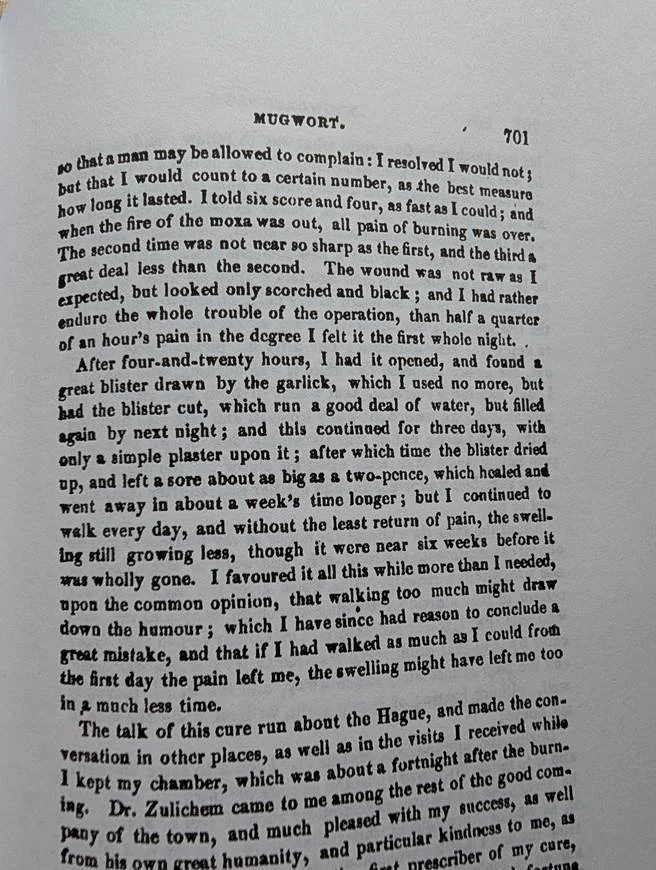
Thornton writes that he felt some relief from the first moxibustion treatment, and complete relief with mobility and comfort bearing his weight and walking after the third treatment.
In our time, herbalist Michael Moore writes that for optimal moxa, the material for moxibustion, “use the young shoots when one to one and one-half feet tall, in April or early May.”² One may also consider freezing or freeze-drying fresh Mugwort leaves.
Gout affects up to 4% of the populations of Europe and North America, and it is six times more common in men than in women. Gout is correlated with angina and other cardiovascular conditions³ and hyperuricemia, which is high uric acid in the blood.
After gout was induced in lab mice, Mugwort “significantly decreased edema in the mice’s feet, following carrageenan-induced inflammation.”⁴ (Carrageenan is a common industrial additive to processed foods consumed in the U.S.)
For repair of liver damage from seed oils and other peroxidation
Herbalist Michael Moore writes that a cold infusion (an iced tea) of the herb is used for liver repair.
Multiple components of Mugwort likely contribute to a reduction of fat storage in the liver, and even showed reduced atherogenesis in blood vessels,⁵ which is possibly a consequence of the “clean-up” of the liver, because a cause of atherosclerosis is peroxidative modification of LDL cholesterol,⁶ as discussed below.
Other uses
Herbalist Nicholas Culpeper MD wrote in 1653, in The Complete Herbal, that Mugwort is helpful in childbirth, “to help the delivery of the birth, and expel the after-birth.”
He also writes that it “breaks the stone, and opens the urinary passages when they are stopped.”
Culpeper also writes that Mugwort “is a special remedy upon the overmuch taking of opium.”
Regarding sciatica, he writes, “Three drams of the powder of the dried leaves taken in wine, is a speedy and a best certain help for the sciatica.”⁷
In our time, herbalist Michael Moore writes of the use of Mugwort as a diaphoretic and expectorant to induce sweating “and a thorough cleaning out of the sinuses when you start to feel those cold and flu symptoms.”⁸
Pharmacology and Mechanisms of Action
Non-alcoholic fatty liver disease (NAFLD) is the most common cause of fatty liver disease. This author has seen, in over twenty years of medical practice, far more fatty liver conditions in those who have taken many pharmaceuticals over their lifetimes than those with habitual alcohol use. NAFLD is a range of pathologies from simple steatoses, which is accumulation of triglycerides in the liver, to fibrosis and even cirrhosis and end-stage liver failure. There are no drugs that treat NAFLD, because it is indeed a drug-induced problem. This clinic has successfully treated with high dose vitamin C and other nutrients intravenously each of the above stages except late cirrhosis and end-stage liver disease.
Six or more distinct components of Mugwort are likely contributors to reduce peroxides in the liver. These include the volatile oils, sesquiterpene lactones, tannins and flavonoid antioxidants, phenolic compounds as well as saponins.⁹ Let’s examine each of these.
The volatile oils of Mugwort, like cloves and creosote, have been shown to reduce the effects on the liver of lipid peroxides, which are basically rancid fats. Animal studies have found that Mugwort extract lowers hepatic lipid peroxidation.¹⁰
Flavonoids carry antioxidants and therefore serve as potent scavenger molecules of oxidants, such as hydroxyl radicals or peroxy radicals. Flavonoids also help to carry cholesterol and lipids out with the stool. When antioxidant enzymes were observed to be low, lipid peroxidation was high, and so was hepatic injury.¹¹
Mugwort contains tannins which are even stronger in antioxidant effects than flavonoids, and especially so with regard to the oxidation of lipids, mostly due to the “large number of free hydroxyl groups bound to the aromatic ring in the tannin molecule.”¹²
One of the main effects of Mugwort in reversing the cellular membrane damage caused by the free radicals associated with lipid peroxides is the following: A closely related plant Artemisia dracunculus, common Tarragon, is shown to suppress malondialdehyde (MDA).¹³ It is thought to accomplish this by its phenolic content. Phenolic compounds in Mugwort also contribute to its antioxidant effect.
Saponins are also a component of Mugwort, which simplistically, have a soap-versus-grease effect on fats in the liver and blood. This is because the saponins cause resin-like action, precipitating cholesterol from the micelles which carry them, which has the effect of lowering the enterohepatic circulation of bile acids, which in turn releases more of cholesterol and lipids into the stool, rather than reabsorption into the body.¹⁴ ¹⁵
Paraoxonase-1 (PON1) is a very helpful ester hydrolase enzyme that we make in the liver, and then is packaged into HDL cholesterol. Its useful features are that it is both lipophilic and antioxidant. Thus, it helps protect against the peroxidation of lipids, including the lipids in LDL cholesterol.¹⁶ This helps to prevent atherosclerotic plaques.¹⁷ Luteolin is a compound in Mugwort that was shown to significantly increase PON1 activity.¹⁸
Mugwort extract also significantly reduced inflammatory molecule TNF-α,¹⁹ which likely resulted from a combination of the above classes of phytochemicals present in Mugwort.
Gout
Mugwort contains, besides the above phytochemicals, sesquiterpene lactones, such as santonin. The lactone ring seems to be the main site of metabolism.²⁰ Sesquiterpene lactones have potent anti-inflammatory and antioxidant effects. They have been found to reduce lipid peroxidation in the liver.²¹ This class of biochemical has been found to decrease inflammation in four ways: 1) as an obstacle to the release of neutrophils to an inflamed area, 2) by blocking release of the pro-inflammatory cytokine TNF-α, by activating 3) superoxide dismutase and 4) catalase.²² Also, sesquiterpene lactones reduce uric acid levels in the blood, hyperuricemia, which is the main cause of gout.²³
Mugwort’s flavonoids, such as luteolin, apigenin and quercetin, having antioxidant effect, may also be considered helpful against the inflammation of gout²⁴ as well as preventing the formation of the painful gout crystals, and it likely accomplishes this by significant reduction of xanthine oxidase, which is the body’s enzyme used to produce uric acid.²⁵ Then when Mugwort lowers the concentration of this enzyme below the saturation point where crystals form, the crystals dissolve on their own.²⁶
Mugwort taken internally, therefore, can prevent the formation of gout crystals. However, for resolution of a gout flare, moxibustion has given curative relief.
Mugwort in moxibustion
Mugwort is a widely accessible and easily harvested herb, so prolific that it is often labelled as a weed. Historically, its selection for moxibustion is due to the tactile quality that its dried leaves can be processed into a soft, fluffy material “moxa wool,” and that it ignites easily and hold a steady ember. Then it burns slowly and at a reliably steady temperature. This made Mugwort optimal for forming into a dense cone shape, placed over the painful area, and then lit at the tip, in order to release a slow infrared heat as it burns, which penetrates deep into tissues.
Four thousand year old moxibustion is seen as such an integral part of Traditional East Asian Medicine, practiced in China and Japan, that acupuncture and moxibustion are written as two characters that comprise the one concept of Zhenjiu or Shinkyu, sometimes translated to English as “acumoxa,” and written in Chinese as follows:²⁷
针灸
In Traditional Chinese Medicine, this warm burning is thought to expel cold and dampness, as well as clearing stagnation of qi energy, and the stagnation of blood. In the example above of an early 19th century herbalist, he watched his (otherwise intractable) swelling reduce as the moxa burned.
This is likely due to the reduction – during moxibustion - of the inflammatory protein NF-κB, as well as protection of the Nrf2 protein, which affects inflammatory interleukins.²⁸ The NF-κB protein has a deleterious effect on a cascade of cell signaling that maintains oxidation-reduction homeostasis, as well as effects on interleukins, TNF-α, and other pro-inflammatory genes.²⁹
Side Effects and Contraindications
Mugwort is an emmenagogue in that it stimulates the uterine mucosa. Therefore, it should not be used during pregnancy, but for the same reason, it has been helpful in childbirth to stimulate a productive labor and afterbirth.
Native Origin and Range
Mugwort is in the Asteraceae family, which is remarkable for its abundance of sesquiterpene lactones generally. Mugwort is native to the British Isles, and grows throughout Europe and Asia. For centuries, it has been used in India and China as the preferred plant for moxibustion. It also grows throughout the Americas.
There is a variety endemic to California, known as Artemisia vulgaris douglasiana. This has similar properties and uses to Mugwort from elsewhere. Herbalist Michael Moore writes, “As long as the dried herb maintains its strong scent when crushed it is useful. This usually means from one to two years, depending on how well it is stored.”³⁰
-
R Thornton. A New Family Herbal [book]. 1814. London. R. and R. Crosby and Co. Stationers. pp. 700-701
M Moore. Medicinal Plants of the Desert and Canyon West [book]. 1989. Santa Fe. Museum of New Mexico Press. p. 21.
R Abbott, F Brand, et al. Gout and coronary heart disease: The Framingham study. Jun 29 1987. J Clin Epidem. 41 (3). 237-242. https://www.sciencedirect.com/science/article/abs/pii/0895435688901278
P Trinh, N Truc, et al. A study on the antioxidant, anti-inflammatory, and xanthine oxidase inhibitory activity of the Artemisia vulgaris L. extract and its fractions. Nov 2024. J Ethnopharmacol. 15:334:118519. https://pubmed.ncbi.nlm.nih.gov/38971340/
W El-Tantawy. Biochemical effects, hypolipidemic and anti-inflammatory activities of Artemisia vulgaris in hypercholesterolemic rats. Apr 18 2015. J Clin Biochem Nutr. 57 (1). 33-38. https://pmc.ncbi.nlm.nih.gov/articles/PMC4512891/
M Ramírez-Tortosa, M Mesa, et al. Oral administration of a turmeric extract inhibits LDL oxidation and has hypocholesterolemic effects in rabbits with experimental atherosclerosis. Dec 1999. Atherosclerosis. 147 (2). 371-378. https://pubmed.ncbi.nlm.nih.gov/10559523/
N Culpeper. The Complete Herbal [book]. 1653. London. Thomas Kelly. [Note to readers: Texts from several centuries earlier have been re-printed since then without page numbers.]
M Moore. Medicinal Plants of the Desert and Canyon West [book]. 1989. Santa Fe. Museum of New Mexico Press. p. 21.
W El-Tantawy. Biochemical effects, hypolipidemic and anti-inflammatory activities of Artemisia vulgaris in hypercholesterolemic rats. Apr 18 2015. J Clin Biochem Nutr. 57 (1). 33-38. https://pmc.ncbi.nlm.nih.gov/articles/PMC4512891/
W El-Tantawy. Biochemical effects, hypolipidemic and anti-inflammatory activities of Artemisia vulgaris in hypercholesterolemic rats. Apr 18 2015. J Clin Biochem Nutr. 57 (1). 33-38. https://pmc.ncbi.nlm.nih.gov/articles/PMC4512891/
J Santos, O Araújo, et al. Choline and cystine deficient diets in animal models with hepatocellular injury: Evaluation of oxidative stress and expression of RAGE, TNF-α and IL-1β. Jun 2015. Oxid Med Cell Longev. 2015:121925. https://pmc.ncbi.nlm.nih.gov/articles/PMC4468296/
Z Sroka. Antioxidative and antiradical properties of plant phenolics. Apr 25 2005. Life Sciences; Z Naturforsch. 60. 833-843. https://www.degruyterbrill.com/document/doi/10.1515/znc-2005-11-1204/html
V Zarezade, J Moludi, et al. Antioxidant and hepatoprotective effects of Artemisia dracunculus against CCl 4 -induced hepatotoxicity in rats. Jan-Feb 2018. Avicenna J Phytomed. 8 (1). 51-62. https://pmc.ncbi.nlm.nih.gov/articles/PMC5787997/
N Visavadiya, A Narasimhacharya. Asparagus root regulates cholesterol metabolism and improves antioxidant status in hypercholesterolemic rats. Aug 27 2008. Evid Based Complement Alternat Med. 6 (2). 219-226. https://pmc.ncbi.nlm.nih.gov/articles/PMC2686619/
H Harwood, C Chandler, et al. Pharmacologic consequences of cholesterol absorption inhibition: alteration in cholesterol metabolism and reduction in plasma cholesterol concentration induced by the synthetic saponin beta-tigogenin cellobioside (CP-88818; tiqueside). Mar 1993. J Lipid Res. 34 (3). 377-395. https://pubmed.ncbi.nlm.nih.gov/8468523/
A Watson, J Berliner, et al. Protective effect of high density lipoprotein associated paraoxonase. Dec 1995. J Clin Invest. 96 (6). 2882-2891. https://pmc.ncbi.nlm.nih.gov/articles/PMC185999/
M Mackness, S Arrol, et al. Protection of low-density lipoprotein against oxidative modification by high-density lipoprotein associate paraoxonase. Dec 1993. Atherosclerosis. 104 (1-2). 129-135. https://pubmed.ncbi.nlm.nih.gov/8141836/
C Schrader, I Ernst, et al. Genistein as a potential inducer of the anti-atherogenic enzyme paraoxonase-1: studies in cultured hepatocytes in vitro and in rat liver in vivo. Sep 26 2012. J Cell Mol Med. 16 (10). 2331-2341. https://pmc.ncbi.nlm.nih.gov/articles/PMC3823426/
W El-Tantawy. Biochemical effects, hypolipidemic and anti-inflammatory activities of Artemisia vulgaris in hypercholesterolemic rats. Apr 18 2015. J Clin Biochem Nutr. 57 (1). 33-38. https://pmc.ncbi.nlm.nih.gov/articles/PMC4512891/
M Grafakou, C Bardda, et al. Study on the metabolism of natural sesquiterpene lactones in human liver microsomes using LC-Q-TOF-MS/MS. Jun 2024. Nat Prod Res. 38 (11). 1855-1863. https://pubmed.ncbi.nlm.nih.gov/37354443/
A Mahesh, R Jeyachandran, et al. Jun 2010. Hepatocurative potential of sesquiterpene lactones of Taraxacum officinale on carbon tetrachloride induced liver toxicity in mice. Acta Biol Hung. 61 (2). 175-190. https://pubmed.ncbi.nlm.nih.gov/20519172/
A Fernandes, R Cunha, et al. Sesquiterpene lactones from Lychnophora species: Antinociceptive, anti-inflammatory, and antioxidant pathways to treat acute gout. Apr 6 2021. J Ethnopharm. 269. https://www.sciencedirect.com/science/article/pii/S0378874120336266
A Fernandes, G Coelho, et al. In vivo anti-hyperuricemic activity of sesquiterpene lactones from Lychnophora species. Jul 4 2018. Braz J Pharmacognosy. 29. 241-245. https://pdf.sciencedirectassets.com/306147/1-s2.0-S0102695X19X00034/1-s2.0-S0102695X1830334X/main.pdf
F Haidari, M Rashidi, et al. Effects of onion on serum uric acid levels and hepatic xanthine dehydrogenase / xanthine oxidase activities in hyperuricemic rats. 2008. Pakistan J Biol Sci. 11 (14). 1779-1784. https://scialert.net/fulltext/?doi=pjbs.2008.1779.1784
P Trinh, N Truc, et al. A study on the antioxidant, anti-inflammatory, and xanthine oxidase inhibitory activity of the Artemisia vulgaris L. extract and its fractions. Nov 2024. J Ethnopharmacol. 15:334:118519. https://pubmed.ncbi.nlm.nih.gov/38971340/
F Abu Bakar, M Abu Bakar, et al. Anti-gout potential of Malaysian medicinal plants. Mar 2018. Front Pharmacol. 9 (261). https://pmc.ncbi.nlm.nih.gov/articles/PMC5876239/
J Li, X Hu, et al. Therapeutic effects of moxibustion simultaneously targeting Nrf2 and NF-κB in diabetic peripheral neuropathy. Jun 17 2019. 189 (4). 1167-1182. https://pmc.ncbi.nlm.nih.gov/articles/PMC6882806/
J Li. Ibid.
V Ganesh, G Negi, et al. Potential therapeutic effects of the simultaneous targeting of the Nrf2 and NF-κB pathways in diabetic neuropathy. Aug 1 2013. Redox Biol. 1 (1). 394-397. https://pmc.ncbi.nlm.nih.gov/articles/PMC3757712/
M Moore. Medicinal Plants of the Desert and Canyon West [book]. 1989. Santa Fe. Museum of New Mexico Press. p. 21.
