
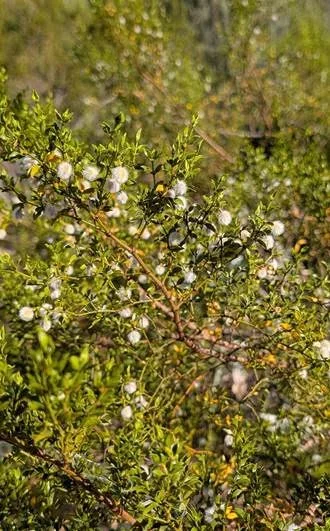
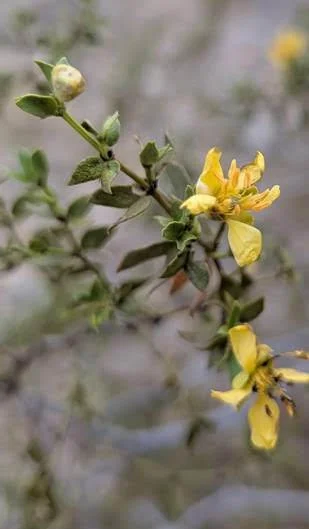
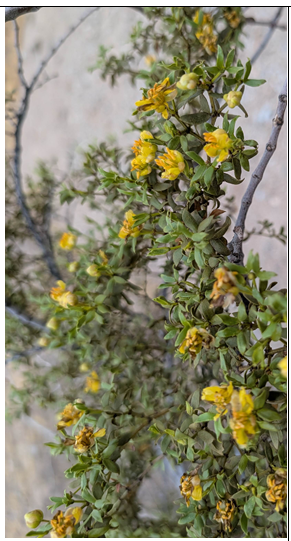
Creosote bush with seed capsules and with spring blossoms
Larrea tridentata, commonly known as Creosote bush or Chaparral; leaves and twigs
Uses
One of the top three herbs for counteracting peroxidation of fats in the liver; treatment for fatty liver and diabetes and metabolic syndrome; anti-inflammatory and antioxidant components of these effects
Anti-bacterial, against both Gram positive and negative bacteria; as a wound-dressing; disrupts biofilms
Anti-viral against RNA and DNA viruses, including Herpes simplex.
Anti-cancer
For reduction of fats in the liver
In a controlled clinical trial in hamsters, creosote was found to reduce fats in the liver. It also prevented weight gain and reduced the storage of fat in other bodily tissues. Plasma glucose was also reduced, as well as plasma insulin and leptins. Also, insulin sensitivity was improved. These changes all occurred within a two-week treatment period, and the creosote results were superior to the fat lowering drug ezetimibe. Creosote lowered both body weight and storage of fat in the body, which ezetimibe did not accomplish.¹
The key component of creosote is nordihydroguaiaretic acid, NDGA, which is an antioxidant and lipoxygenase inhibitor, discussed below in the Pharmacology section.
For lowering dietary lipid peroxides in the liver, herbalist Michael Moore recommended combining creosote with the herb milk thistle.²
For insulin sensitivity
In a study in mice over 16 weeks, NDGA significantly improved blood triglycerides, inflammatory chemokines, hyperinsulinemia and insulin sensitivity. Blood triglycerides reduced by 14%, and liver triglycerides reduced by over 17%. Fatty liver aka liver steatosis was “significantly improved.”³ Insulin sensitivity in lab mice also improved in a different study of mice fed NDGA for 8 weeks.⁴
For anti-cancer effect
NDGA extract from creosote bush inhibited human breast cancer cells, both in vitro and in vivo transplanted to mice.⁵ The effects of seventeen compounds from Larrea tridentata were examined for their effects against human promyelocytic leukemia cells. Of those seventeen, eleven compounds were found to be cytotoxic to HL-60 human leukemia cells.⁶
NDGA was also shown to decrease the viability and proliferation of non-small cell lung cancer in all seven cell lines tested, and “drastically decreased the colony-forming capacity” of the cells tested.⁷
For antibacterial effect
Creosote is another plant that is ubiquitous in the desert southwest, like prickly pear and aloe, that have antimicrobial effects in both oral use and topical application.
Even in very low concentrations of one and two mg per ml, alcohol extract of creosote completely inhibited growth of a Pseudomonas species.⁸
The rate of infections showing bacterial resistance to antibiotics is growing faster than new antibiotic development.⁹ Therefore, it is increasingly urgent to look to the plant kingdom for its antibacterial tools.
Creosote extract has been shown to be 2,000 to 8,000 times stronger than the penicillins class of β-lactam antibiotics against Staphylococcus. Staphylococcus aureus (including penicillin resistant Staph. aureus) was inhibited at only 20 micrograms per ml, and Streptococcus pyogenesis was inhibited at only 30 micrograms per ml concentrations respectively. Heating did not diminish this effect, and the creosote extract was also found to potentiate the penicillin class of antibiotics when used in combination.¹⁰
For topical use and vulnerary effects
Herbalist Michael Moore has recommended creosote leaves and twigs applied topically as “a very useful first aid or long-term dressing for skin abrasions and injuries for man or beast…”¹¹ Herbalist John Slattery advises to “apply the wash, oil, infusion, salve, poultice, leaf powder or tincture to a variety of wounds, burns, cuts, abrasions, scrapes, bruises, damp inflammations, skin infections, fungal infections, mosquito bites, venomous bites, stings or other blemishes or injuries to the skin.”¹²
If the above categories of use seem rather broad, it should be noted that documented uses of Larrea tridentata by indigenous people, as recognized in conventional medical literature, encompass over fifty (50) disease conditions.¹³
For antiviral effect
NDGA extracted from creosote has been observed to have a broad antiviral function. Dengue virus, Zika virus and West Nile virus (WNV) are RNA viruses that are targeted by NDGA. WNV is a mosquito-borne infectious agent that is inhibited in its replication within two hours post-viral uptake by a concentration of 29.8 μM.¹⁴
DNA viruses are also vulnerable to NDGA. It is estimated that herpes simplex virus type 1 (HSV-1) infects more than 70% of people worldwide, mostly as a permanent latent infection. A water soluble derivative of NDGA was able to inhibit transcription of HSV-1 ICP4, which is a gene that plays a major role in early replication steps of the virus. This was also the case in strains of the virus that are resistant to the main pharmacological treatment of HSV, namely acyclovir.¹⁵
Herbalist John Slattery recommends topical application of creosote to Herpes simplex 1 and 2 lesions. We consider the oil of creosote most practical for this purpose.¹⁶ It may sting.
Pharmacology and Mechanisms of Action
Non-alcoholic fatty liver disease (NAFLD) is the most common cause of fatty liver disease. This author has seen, in over twenty years of medical practice, far more fatty liver conditions in those who have taken many pharmaceuticals over their lifetimes than those with habitual alcohol use. NAFLD is a range of pathologies from simple steatoses, which is accumulation of triglycerides in the liver, to fibrosis and even cirrhosis and end-stage liver failure. There are no drugs that treat NAFLD, because it is indeed a drug-induced problem. This clinic has successfully treated with high dose vitamin C and other nutrients intravenously each of the above stages except late cirrhosis and end-stage liver disease.
The most studied active compound in creosote bush is nordihydroguaiaretic acid (NDGA). It is potently antioxidant, but caution must be used when taking it, and it should be taken short-term, not long-term. See Side Effects and Contraindications below.
In the study of liver fats in hamsters mentioned above, creosote bush extract was found to decrease lipid peroxidation and to increase the antioxidant capacity of the liver.¹⁷ An earlier study in rats showed that NDGA reduced the liver’s secretion of triglycerides, and the liver’s triglyceride content, and NDGA increased the clearance of triglycerides from the blood.¹⁸
The mechanism of the hypolipidemic effect of NDGA is that it promotes increased fatty acid oxidation via the mitochondrial β-oxidation system. Gene expression for β-oxidation was affected and upregulated by NDGA treatment.¹⁹
NDGA is a potent lipoxygenase inhibitor. The mechanism of that activity is NDGA’s stimulation of a hormone receptor in the cell nucleus, which is peroxisome proliferator-activated receptor α (PPAR-α). This is the main hormone regulating the three main fatty acid oxidation systems in the liver.²⁰ Those are mitochondrial and peroxisomal β-oxidation and microsomal ω-oxidation. PPAR-α also regulates lipoprotein synthesis, fatty acid catabolism and energy uncoupling in adipose tissue. PPAR-α is the central coordinator of multiple metabolic pathways related to the metabolism of fatty acids in the liver, including the uptake, transport and metabolism of fatty acids, ketogenesis, the β-oxidation of peroxisomal and mitochondrial fatty acids, as well as ω-oxidation and peroxisomal fatty acid uptake.²¹ Essentially, PPAR-α plays a critical part in the oxidation of fats, and is therefore essential for the use of ATP as energy.
However, sustained activation of PPAR-α is likely undesirable. See Side Effects and Contraindications below.
For insulin sensitivity
In a study noted above, mice were fed a diet with high NDGA for 16 weeks. The response was that insulinemia levels were greatly reduced. Insulin sensitivity and glucose intolerance all significantly improved.²² Even at very low concentrations of 10 muM or less, NDGA has been seen to inhibit activation of the insulin-like growth factor receptor (IGF-1R).²³ This in turn has the effect of suppressing the release of insulin from the pancreas and increasing insulin sensitivity.
For antioxidant and anti-inflammatory effects
The antioxidant properties of NDGA have been verified chemically due to its scavenging activity of a variety of reactive oxygen species (ROS).²⁴
For antibacterial use
Creosote extract showed β-lactam-like antibiotic activity and β-lactam presence on ELISA assay. It is not known if the β-lactam activity was produced by the creosote bush or by a commensal endophytic microbe associated with creosote.²⁵ Besides NDGA, other extractable secondary metabolites of creosote include flavonoids, other antioxidants and saponins, each of which have known antibacterial effects.²⁶
For antiviral use
In an in vitro infection model, infrared microscopy established viral presence in the nuclear and perinuclear areas of examined cells, followed by proliferation of West Nile virus proteins. After addition of NDGA, a dose-dependent inhibition of viral replication was seen of up to 91.1% inhibition, with selectivity for replication of West Nile virus over replication of host cells. This showed that NDGA’s antiviral activity occurs inside the host cells and targets the earliest steps in the West Nile virus replication cycle.²⁷ Pharmacological modification of a host cell’s lipid metabolic pathways are an observed mechanism of creosote’s and specifically NDGA’s antiviral effects.²⁸
For anti-cancer effect
Approximately 60% of anticancer agents in conventional oncology use come from such natural materials as the marine environment, microbes and slime molds.²⁹ Therefore, the plant kingdom’s generous abundance of anti-cancer remedies should be no surprise.
NDGA induced cell death in non-small cell lung cancer cells, at least in part by reducing glucose uptake. NDGA also induces cell death by making cancer cell membranes permeable, and thus vulnerable to extracellular environmental fluctuations, even at very small concentrations, and while the effect of NDGA on non-cancer cells are “none or minimal.”³⁰ These effects are in turn the likely cause of reduced proliferation and apoptosis in cancer cell lines. Also, the same lipoxygenase inhibitors that are shown to be hepatoprotective, as discussed above, are also found to prevent carcinogenesis in the lungs and to inhibit the growth of non-small cell lung cancer, by way of opposing lipoxygenase mRNA that was detected by PCR in lung cancer cells.³¹
Side Effects and Contraindications
Creosote is used for short courses and cautiously. Although creosote has had many and widespread reports of healing of the liver, it is very potent, and has been taken mistakenly at high dose by laypeople unfamiliar with this herb’s potency and properties. Anecdotal reports of liver irritation have been made.
One cannot suggest strongly enough to see a naturopathic physician for root-cause diagnosis of medical concerns, and for proper dosing of individually appropriate herbs and nutrients. At this time, we are recommending no more than a two week course of this herb, of one dropperful of the ethanol-extract tincture two to three times per day, until consulting with a qualified naturopathic physician or herbalist, and with a break of three months between each two-week course, unless specifically and individually instructed otherwise by a knowledgeable and botanically trained healthcare provider.
Native Origin and Range
Creosote bush grows so abundantly on hillsides throughout the Sonoran Desert of Mexico and the Southwest United States that one of its nicknames is the Spanish word Gobernadora, which reflects its tendency to govern a hillside, inhibiting growth of other plants there. However, it is thought to have originated in the arid zones of Argentina and Bolivia, having a disjunct distribution with the North American range.
Another nickname that Spanish speakers have given creosote bush is hediondilla, literally “little stinker,” for the creosote-like fragrance that is so noticeable after rain. This explains the English name for creosote. Another English name for it is chaparral, but this is even more inaccurate than the name creosote, because chaparral refers to an entire biome in which it grows.
Creosote bushes are some of the oldest living plants. One specimen in Imperial County, California was carbon-dated to be over 13,000 years old.³²
-
G Del Vecchyo-Tenorio, M Rodríguez-Cruz, et al. Creosote Bush (Larrea tridentata) improves insulin sensitivity and reduces plasma and hepatic lipids in hamsters fed a high fat and cholesterol diet. Jun 28 2016. 7. 194. https://pmc.ncbi.nlm.nih.gov/articles/PMC4924253/
M Moore. Medicinal Plants of the Desert and Canyon West [book]. 1989. Museum of New Mexico Press. p. 29.
H Zhang, W Shen, et al. Nordihydroguaiaretic acid improves metabolic dysregulation and aberrant hepatic lipid metabolism in mice by both PPAR-α-dependent and -independent pathways. Oct 25 2012. Am J Physiol Gastrointest Liver Physiol. Oct 25 2012. 304 (1). G72-G86. https://pmc.ncbi.nlm.nih.gov/articles/PMC3543637/
J Chan, S Bittner, et al. Nordihydroguaiaretic acid, a lignan from Larrea tridentata (creosote bush), protects against American lifestyle-induced obesity syndrome diet-induced metabolic dysfunction in mice. May 2018. J Pharmacol Exp Ther. 365 (2). 281-290. https://pmc.ncbi.nlm.nih.gov/articles/PMC5878670/
J Youngren, K Gable, et al. Nordihydroguaiaretic acid (NDGA) inhibits the IGF-1 and c-erbB2/HER2/neu receptors and suppresses growth in breast cancer cells. Nov 2005. Breast Cancer Res Treat. 94 (1) 37-46. https://pubmed.ncbi.nlm.nih.gov/16142439/
A Yokosuka, T Iguchi, et al. Structure and cytotoxicity of novel lignans and lignan glycosides from the aerial parts of Larrea tridentata. Oct 13 2021. Molecules. 26 (20). 6186. https://www.mdpi.com/1420-3049/26/20/6186
C Chipón, P Riffo, et al. Impact of nordihydroguaiaretic acid in proliferation, energy metabolism, and chemosensitization in non-small-cell lung cancer (NSCLC) cell lines. Oct 2024. Int J Mol Sci. 25 (21). 11601. https://pubmed.ncbi.nlm.nih.gov/39519155/
D Rivera-Escareño, J Cadena-Iñiguez, et al. Microbicidal activity of extract Larrea tridentata (Sessé and Moc. Ex DC.) Coville on Pseudomans syringae Van Hall and Botrytis cinerea Pers. Mar 2025. Microorganisms. 13. 1055. https://europepmc.org/api/getPdf?pmcid=PMC12113721
M Zhang, X Kong, et al. Research and development of antibiotics: insights from patents and citation network. May 2016. Expert Opin Ther Pat. 26 (5). 617-627. https://pubmed.ncbi.nlm.nih.gov/26986226/
T Turner, G Ruiz, et al. Characterization of the antibacterial activity from ethanolic extracts of the botanical, Larrea tridentata. Jun 25 2021. BMC Compl Med Ther; Springer Nature. 21 (177). https://link.springer.com/article/10.1186/s12906-021-03344-9
M Moore. Medicinal Plants of the Desert and Canyon West [book]. 1989. Museum of New Mexico Press. p. 28.
J Slattery. Southwest Medicinal Plants [book]. 2020. Timber Press, Inc. pp.140-141.
S Arteaga, A Andrade-Cetto, et al. Larrea tridentata (creosote bush), an abundant plant of Mexican and US-American deserts and its metabolite nordihydroguaiaretic acid. 2005. J Ethnopharmacol. 98. 231-239. Table 1. https://d1wqtxts1xzle7.cloudfront.net/48343480/009-libre.pdf
F Martínez, L Ghietto, et al. Mechanistic characterization of the antiviral effects of nordihydroguaiaretic acid against West Nile virus. Mar 27 2026. Virol J. 23 (121). https://pmc.ncbi.nlm.nih.gov/articles/PMC13147777/
R Park, P Giza, et al. Inhibition of HSV-1 replication and reactivation by the mutation-insensitive transcription inhibitor tetra-O-glycyl-nordihydroguaiaretic acid. Mar 2003. Antiviral Res. 58 (1). 35-45. https://pubmed.ncbi.nlm.nih.gov/12719005/
J Slattery. Southwest Medicinal Plants [book]. 2020. Timber Press, Inc. p. 141.
G Del Vecchyo-Tenorio, M Rodríguez- Cruz, et al. Creosote Bush (Larrea tridentata) improves insulin sensitivity and reduces plasma and hepatic lipids in hamsters fed a high fat and cholesterol diet. Jun 28 2016. 7. 194. https://pmc.ncbi.nlm.nih.gov/articles/PMC4924253/
K Scribner, T Gadbois, et al. Masoprocol decreases serum triglyceride concentrations in rats with fructose-induced hypertriglyceridemia. Sep 2000. Metabolism. 49 (9). 1106-1110. https://pubmed.ncbi.nlm.nih.gov/11016888/
H Zhang, Y Li, et al. Effect of creosote bush-derived NDGA on expression of genes involved in lipid metabolism in liver of high-fructose fed rats: Relevance to NDGA amelioration of hypertriglyceridemia and hepatic steatosis. Sep 2015. PLoS One. 10 (9). E0138203. https://pmc.ncbi.nlm.nih.gov/articles/PMC4578927/
S Pyper, N Viswakarma, et al. PPARα: energy combustion, hypolipidemia, inflammation and cancer. Apr 16 2010. Nucl Recept Signal. 8. https://pmc.ncbi.nlm.nih.gov/articles/PMC2858266/
M Rakhshandehroo, B Knock, et al. Peroxisome proliferator-activated receptor alpha target genes. Sep 26 2010. PPAR Res. 2010: 612089. https://pmc.ncbi.nlm.nih.gov/articles/PMC2948931/
H Zhang, W Shen, et al. Nordihydroguaiaretic acid improves metabolic dysregulation and aberrant hepatic lipid metabolism in mice by both PPAR-α-dependent and -independent pathways. Oct 25 2012. Am J Physiol Gastrointest Liver Physiol. Oct 25 2012. 304 (1). G72-G86. https://pmc.ncbi.nlm.nih.gov/articles/PMC3543637/
J Youngren, K Gable, et al. Nordihydroguaiaretic acid (NDGA) inhibits the IGF-1 and c-erbB2/HER2/neu receptors and suppresses growth in breast cancer cells. Nov 2005. Breast Cancer Res Treat. 94 (1) 37-46. https://pubmed.ncbi.nlm.nih.gov/16142439/
J Billinsky, E Krol. Nordihydroguaiaretic acid autooxidation produces a schisandrin-like dibenzocyclooctadiene lignan. Sep 2008. J Nat Prod. 71 (9). 1612-1615. https://pubmed.ncbi.nlm.nih.gov/18672930/
T Turner, G Ruiz, et al. Characterization of the antibacterial activity from ethanolic extracts of the botanical, Larrea tridentata. Jun 25 2021. BMC Compl Med Ther; Springer Nature. 21 (177). https://link.springer.com/article/10.1186/s12906-021-03344-9
R Morales-Márquez, L Delgadillo-Ruiz, et al. Evaluation of Larrea tridentata extracts and their antimicrobial effects on strains of clinical interest. Jan 24 2025. Int J Molec Sci. 26 (3). https://www.mdpi.com/1422-0067/26/3/1032#article-metrics-citations
F Martínez, L Ghietto, et al. Mechanistic characterization of the antiviral effects of nordihydroguaiaretic acid against West Nile virus. Mar 27 2026. Virol J. 23 (121). https://pmc.ncbi.nlm.nih.gov/articles/PMC13147777/
R Soto-Acosta, P Bautista-Caarbajal, et al. Nordihydroguaiaretic acid (NDGA) inhibits replication and viral morphogenesis of dengue virus. Sep 2014. Antivir Res. 109. 132-140. https://www.sciencedirect.com/science/article/abs/pii/S0166354214002010
G Cragg, J Pezzuto. Natural products as a vital source for the discovery of cancer chemotherapeutic chemopreventive agents. Dec 17 2015. Med Princ Pract. 25 (Suppl 2). 41-59. https://pmc.ncbi.nlm.nih.gov/articles/PMC5588531/
C Chipón, P Riffo, et al. Impact of nordihydroguaiaretic acid in proliferation, energy metabolism, and chemosensitization in non-small-cell lung cancer (NSCLC) cell lines. Oct 2024. Int J Mol Sci. 25 (21). 11601. https://pubmed.ncbi.nlm.nih.gov/39519155/
T Moody, J Leyton, et al. Lipoxygenase inhibitors prevent lung carcinogenesis and inhibit non-small cell lung cancer growth. Feb 10 1998. Experimental Lung Res. 24 (4). 617-628. https://doi.org/10.3109/01902149809087390
M Moore. Medicinal Plants of the Desert and Canyon West [book]. 1989 Museum of New Mexico Press. p. 28.
