
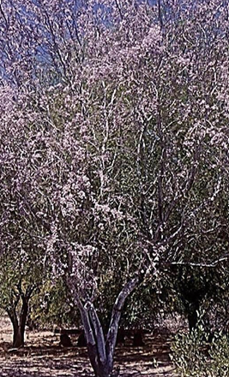
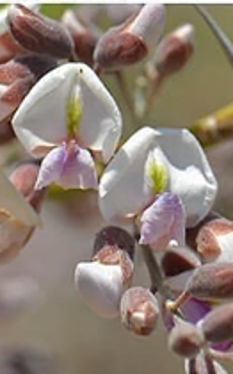
Images from Spadefoot Nursery https://www.instagram.com/p/C3qpgejPUh8/
Desert Ironwood – Olneya tesota seeds
Uses
A tree’s defense against an insect pest turns out to be a specifically selective attack against monocytic leukemia cells.
For acute monocytic leukemia
Of all kinds of acute myelogenous leukemia, 5% to 8% of those cases are acute monoblastic and acute monocytic leukemia.[1] While the Desert Ironwood tree successfully attacks a pest that has long plagued its species, the form of attack happens to be an effective target against a type of leukemia.
Plants are long revered for fighting off their predators and enemies while standing still, barely mobile. While the animal kingdom avails itself of ‘fight or flight’ to deal with predators, plants only have access to the ‘fight’ half of those options. Their main battle strategy is biochemical, consisting of thousands of phytochemicals in each plant that are to some degree poisonous to pests, but have been proven useful as human medicines in small enough doses. In fact, it is estimated that up to 40% of the pharmaceuticals prescribed in the United States originate from plant-derived molecules.[2] Author Gregg Abbott writes:
“Plants have been used as medicine since before the emergence of our species, by early hominids, non-human primates, and even other animals. Homo sapiens has taken this natural apothecary to another level of organization and scale, with perhaps 40% of modern medicines being derived in some form from plants. Our ancestors discovered the medicinal effects of plants by accident, trial and error, and/or learning from effects of similar plants and then experimented with the optimal methods of extraction, combination and application.”
Pharmacology and Mechanisms of Action
Lectin proteins are a useful category of the biochemical arsenal that plants deploy against pests. Mostly they do this by binding to carbohydrates, and then those larger molecules bind to cell surfaces. Although this can be in some cases irritating to the human GI tract, they are even more irritating when binding to glycoproteins and to glycolipids in the lining of insects’ GI tracts.[3]
The wood of the Desert Ironwood is resistant to rotting, likely related to the chemicals used against its natural pests. Thus, ironwood trunks can persist for up to 1600 years,[4] and some living specimens have reached 800 years old.[5]
The Desert Ironwood deploys the PF2 lectin against the larvae of its most noxious pest, resulting in fewer adult beetles.[6][7] It is this same plant chemical the PF2 lectin that attaches to monocytic leukemia cell lines, degrades their DNA and causes those cells to die. This occurred by way of the following mechanism: When PF2 lectin was added to cell lines of monocytic leukemia cells, it caused the phosphatidyl serine molecules at the cell membranes to flip to the outside of the cells. There, the cancer cells became an easy target for zinc,[8] which has many known anti-cancer effects. Also, this flipping caused reactive oxygen species (ROS) to accumulate inside the cell, and lowered the potential of the mitochondrial membrane, which led to the cells’ death.[9] The flipping of phosphatidyl serine to the outside of the cancer cell also targets that cell for destruction by macrophages.[10] Phosphatidyl serine is a wonderfully useful nutrient inside the cell, but it does label cancer cells for destruction when flipped to the outside.[11]
The ROS strategy against cancer is well-established, and is the most commonly understood basis for vitamin C’s effective role in selectively killing cancer cells. The selectivity is that cancer cells lack the enzyme catalase to break down ROS to harmless oxygen and water, but normal cells do have that enzyme.[12] This is one way that cancer has been successfully eliminated for decades with primarily vitamin C treatment.[13] Another major way is that vitamin C eliminates cancer stem cells, as we describe here.[14]
Cancer cells are more vulnerable than normal cells to plant lectins. This is because of the different surface sugar patterns on the surface of cancer cells that attract and preferentially bind lectins. Just as the lectins fight the GI tracts of insect larvae during the life of the plant, those lectin molecules selectively attach to cancer cells and promote the death of those cells by internal build-up of ROS inside the cancer cell, which is another selective mechanism against cancer cells. Furthermore plant lectins were found to modulate apoptotic and autophagic signaling for cancer cell death.[15] The difference with normal cells is that the latter keep phosphatidyl serine locked on the inside layer of the cell.
Research is still very early on the anti-cancer effects of plant lectins in general and Olneya tesota in particular. Because the Olneya tesota lectin PF2 showed general anti-cancer effects, it may be more broadly useful against other types of cancer also.
Side Effects and Contraindications
The PF2 lectin of the Olneya tesota tree is persistently hemagglutinating (clot-forming) over a wide temperature range.[16] The physician must weigh the selective effect against monocytes in leukemia versus the theoretical clot risk when using this as a leukemia treatment, and to decide whether clot prevention such as with use of nattokinase may be warranted as concurrent treatment. This should not be attempted by a layperson working alone. This treatment combination should be used under the care of a competent naturopathic medical doctor (NMD) due to this potential theoretical clot risk.
Native Origin and Range
Olneya tesota grows throughout the Sonoran Desert of southwest Arizona, California, especially in valley floors of the Sonoran Desert. It has some of the hardiest and heaviest wood in the world. These tall long-lived trees are nurse plants for shorter trees, shrubs, cacti, grasses and other plants, up to 178 other species found, and they buffer extreme temperatures and winds, which has the effect of retaining the floral fragrances of the micro-climate site to linger and to attract pollinators.[17]
-
D Casciato, M Territo. Manual of Clinical Oncology [book]. 7 th Ed. 2012. Wolters Kluwer, Lippincott Williams & Wilkins. pp. 629-630.
G Abbott. In search of new medicines from plants. Sep 3 2024. Chem, Cell Biol and Pharmacy and Pharmacology. https://communities.springernature.com/posts/in-search-of-new-medicines-from-plants
A War, M Paulrag, et al. Mechanisms of plant defense against insect herbivores. Oct 1 2012. Plant Signal Behav. 7 (10). 1306-1320. https://pmc.ncbi.nlm.nih.gov/articles/PMC3493419/
M Dimmitt. Biomes and communities of the Sonoran Desert region. 2000. pp 3-18 in S Phillips, P Comus, eds. A Natural History of the Sonoran Desert [book]. Arizona-Sonora Desert Museum Studies in Natural History. University of Arizona Press. Tucson, AZ. Cited in: Biological Survey of Ironwood Forest National Monument. https://www.desertmuseum.org/programs/ifnm_references.php
H Suzán. 1994. Ecological effects of exploitation on Olneya tesota and associated species in the Sonoran Desert. Dissertation, Arizona State University, Tempe, Arizona. Cited in: Biological Survey of Ironwood Forest National Monument. https://www.desertmuseum.org/programs/ifnm_references.php
I Lagarda-Díaz, A Guzmán-Partida, et al. Insecticidal action of PF2 lectin from Olneya tesota (Palo Fierro) against Zabrotes subfasciatus larvae and midgut glycoconjugate binding. Jan 28 2009. J Agric Food Chem. 57 (2). 689-694. https://pubmed.ncbi.nlm.nih.gov/19102651/
I Lagarda-Díaz, M Robles Burgeño, et al. Binding of PF-2 lectin from Olneya tesota to gut proteins of Zabrotes subfasciatus larvae associated with the insecticidal mechanism. Jan 30 2012. J Agricul and Food Chem. 60 (9). https://pubs.acs.org/doi/10.1021/jf2045872
A Kaynak, H Davis, et al. Phosphatidylserine: The unique dual-role biomarker for cancer imaging and therapy. May 21 2022. Cancers (Basel). 14 (10). 2536. https://pmc.ncbi.nlm.nih.gov/articles/PMC9139557/
D Vilegas-Coronado, J Soto-Guzmán, et al. Jul 2023. Chem & Biodivers. 20 (7). https://onlinelibrary.wiley.com/doi/epdf/10.1002/cbdv.202300051
A Kaynak, H Davis, et al. Phosphatidylserine: The unique dual-role biomarker for cancer imaging and therapy. May 21 2022. Cancers (Basel). 14 (10). 2536. https://pmc.ncbi.nlm.nih.gov/articles/PMC9139557/
R Birge, S Boeltz, et al. Phosphatidylserine is a global immunosuppressive signal in efferocytosis, infectious disease and cancer. Jun 2016. Cell Death Differ. 23 (6). 962-978. https://pubmed.ncbi.nlm.nih.gov/26915293/
Q Chen, M Espey, et al. Pharmacologic ascorbic acid concentrations selectivelyh kill cancer cells: Action as a pro-drug to deliver hydrogen peroxide to tissues. Sep 12 2005. Proc Natl Acad Sci 102 (38). 13604-13609. https://pmc.ncbi.nlm.nih.gov/articles/PMC1224653/
C Huber. Defeating cancer requires more than on treatment method: An 11-year retrospective case series using multiple nutritional and herbal agents, 2017 update. Dec 30 2017. Nature Works Best Clinic. https://natureworksbest.com/s/Cancer-Treatment-Paper-2017.pdf
A Bradford. How vitamin C kills cancer, including cancer stem cells. Jul 20 2026. Nature Works Best Cancer Clinic. https://natureworksbest.com/articles/how-vitamin-c-kills-cancer-including-cancer-stem-cells
S Ramsridhar, C Rajkumar, et al. The promising role of plant-derived lectins in oral cancer therapeutics: A systematic review. Dec 17 2024. Cureus. 16 (12). https://pmc.ncbi.nlm.nih.gov/articles/PMC11739538/
E Acedo-Espinoza, I Lagarda-Díaz, et al. Insights into the structural features, conformational stability and functional activity of the Olneya tesota PF2 lectin. Aug 13 2020. Protein & Peptide Letters. 28 (4). https://www.eurekaselect.com/article/109107
G Nabhan, E Daugherty, et al. Health benefits of the diverse volatile oils in native plants of ancient ironwood-giant cactus forests of the Sonoran Desert: An adaptation to climate change? Mar 10 2022. Int J Environ Res Public Health. 19 (6). 3250. https://pmc.ncbi.nlm.nih.gov/articles/PMC8950382/
