
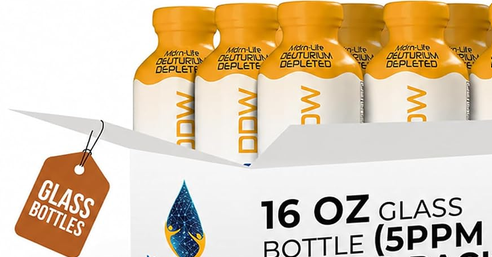
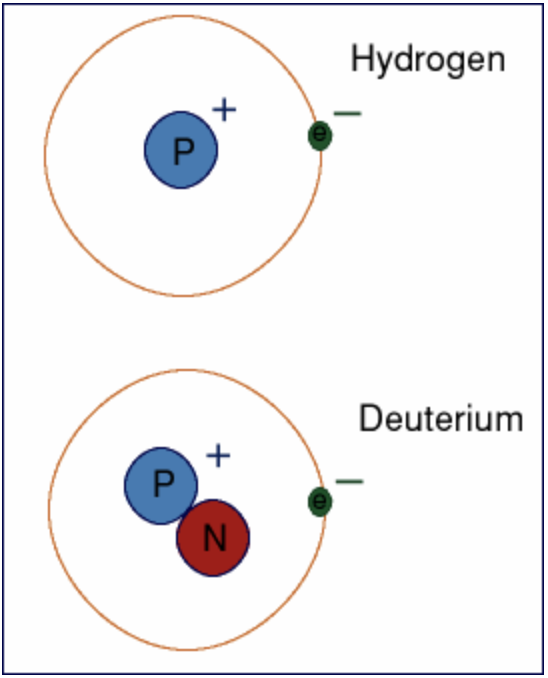
Images from https://www.amazon.com/Mdrn-Life-Deuterium-DDW-Additives-Chemicals/dp/B0CB9Z4H9D and B Wood, J Linsky, et al. in The Deuterium Puzzle¹
Deuterium (²H) is a variant molecule of hydrogen. Unlike protium, the common and abundant form of hydrogen, deuterium also contains a neutron in the nucleus, which protium does not have. Deuterium occurs naturally throughout the world, as part of “heavy water,” written as D₂O or ²H₂O, in ocean water as well as in fresh water. In the human body, the average concentration is 150 parts per million. In very high concentrations, such as 350,000 parts per million, deuterium is toxic to all observed life from microbial to human.² On the other hand, the low concentration of five parts per million in the advertisement photo above, and similarly low concentration, is the subject of Gábor Somlyai’s 2022 book Deuterium Depletion: A New Way in Curing Cancer and Preserving Health.³
Deuterium-depleted water for drinking is water in which deuterium concentration has been reduced. Deuterium-depleted water can be expensive, and in the photo above, at this writing, costs $166 for 12 bottles of 500 ml each. However, that is more concentrated than recommended in Somlyai’s book. So if one $14.00 bottle of the above were diluted with regular drinking water of 150 ppm to result in the 125 ppm x 2.0 liters per day, then one would dilute one bottle of 500 ml deuterium-depleted water with 1.5 liters of regular water, and drink that entire amount of water throughout the day. At the above price, that would amount to about $13.80 per day.
Low deuterium levels are correlated in animal studies with a number of health benefits, such as long-term memory,⁴ avoidance of depression,⁵ and in some circumstances anti-aging.⁶
Deuterium is more abundant in carbohydrates than in animal products. Lard has only 118 ppm deuterium and butter has 124 ppm. Sugar and flour, on the other hand, have 146 and 150 ppm respectively.⁷ The more carbon atoms that originate from fatty acids, the lower the deuterium concentration of the water in the body’s cells.⁸ These observations may have some relation to the observation that keto diets, high in animal products, have been observed to be helpful against cancer, while high-carbohydrate, high-sweet, vegan and vegetarian diets have each been found to have been more common for years prior to cancer diagnosis among cancer patients than in the general population.⁹ ¹⁰
How excess deuterium is toxic
Higher levels of deuterium are needed for cell reproduction and are correlated with increased cell proliferation, which is much more frequently occurring in active cancer than in normal tissue. As a cell enters mitosis, deuterium concentrations can nearly triple.¹¹
Deuterium is an obstacle to optimal functioning of the mitochondria to produce ATP in that it creates a kinetic drag on that function, because it has double the mass of protium, and its larger, one might say clunkier, ionic radius impedes its movement and dissociation through narrow pathways.¹² That kinetic drag is explained well in the Body Insight blog.¹³
Also, cancer cells are characterized by few and malfunctioning mitochondria. When they malfunction, they cannot perform the normal function of pumping excess deuterium out. Then deuterium accumulates, resulting, at certain ranges of concentration, in unopposed proliferation. However, cancer cells use up deuterium more quickly than normal cells, because they reproduce quickly, using deuterium for this function. Therefore, people with active cancer develop a lower blood plasma deuterium concentration, of 142.4 ppm, than in healthy individuals, 149 ppm, because cancer patients’ tumors consume high levels of deuterium for frequent cell reproduction in tumors.¹⁴
Low deuterium concentration has shown multiple anti-cancer effects
The proliferation and division of tumor cells is suppressed in a deuterium-depleted environment.¹⁵ Tumor cells lose their “immortality” in a low-deuterium environment, as deuterium-depleted water triggers apoptosis, a form of cell death. In the same study, it was shown that the tumor weight decreased by approximately 30% in the treated group. However, the control group of normal cells showed no measured effects at all, which is an encouraging finding, in that deuterium depletion has not been seen to damage normal cells.¹⁶
Another advantage of a low deuterium cellular environment is that malignant cells consume more deuterium than normal cells, The impossible situation faced by a cancer cell in a low deuterium environment is that a lot of deuterium is needed for excessive cancer cell reproduction, but there is not adequate deuterium for that to occur. So then the cell undergoes oxidative stress, apoptosis and at larger scale, tissue necrosis.¹⁷ Therefore, using a strategy of consuming deuterium-depleted water may be one of the benign ways to starve cancer of what it needs, without harming normal cells.¹⁸ ¹⁹
Low deuterium water also improves the genotype of a cancer cell, in that it inhibits expression of the COX-2 gene, which inhibits prostaglandin synthesis. COX-2 expression is generally correlated with worse cancer outcomes. Cancer is known to be a genetically chaotic disease, mutating so fast and unpredictably that genetic differences have been found to occur even within the same tumor. Deuterium contributes to genetic mutations and defects.²⁰
Cancer is a metabolic disease, a genetic disease, and perhaps ultimately a deuterium excess disease
Cancer has been shown to be a metabolic disease. In a healthy cell, robust mitochondrial respiration displaces the anaerobic glycolysis favored by cancerous cells. In high-concentrations of deuterium, mitochondrial respiration was almost completely inhibited.²¹
For decades, the genetic explanation of cancer has competed with the metabolic explanation of cancer as the root cause behind this disease. Deuterium is a factor that underlies both. Whether we observe that unfortunate genes or a high-carbohydrate diet risks and worsens cancer, elevated deuterium correlates with both of these factors, and correlates with worse cancer outcomes.²²
Reported results of deuterium depletion in human cancer patients
For each of the following cancers, patients had better results in complete or partial regression of their tumors as well as better long-term remission rates: cancers of the breast, prostate, lung and colon.²³
Caveats to the claimed effects of deuterium on cancer
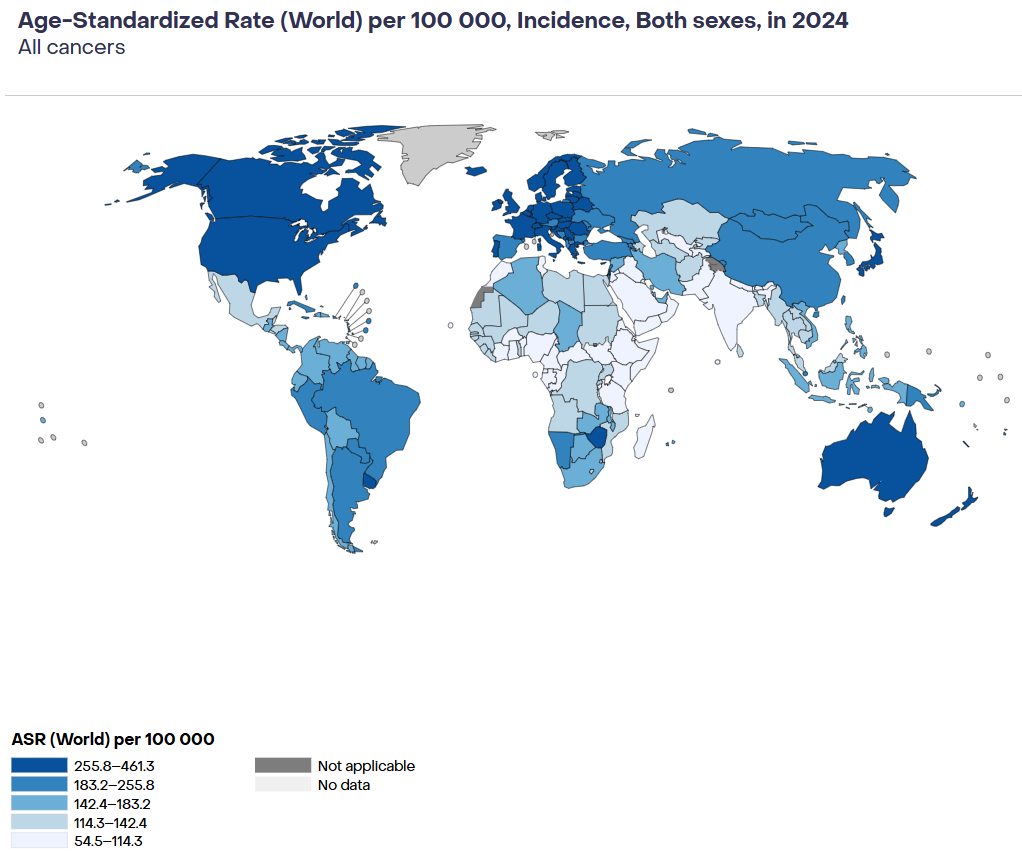
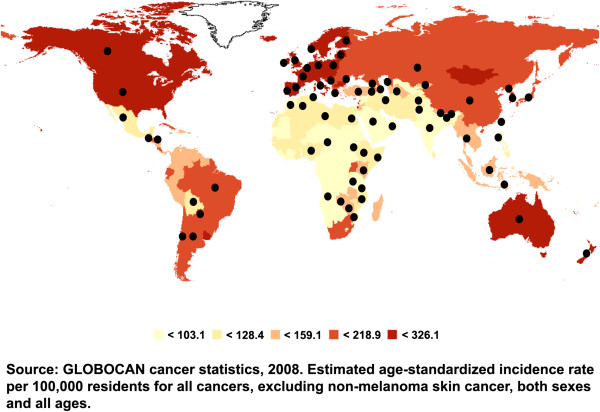
Cancer occurs more commonly in temperate zones than near the equator. This has been the case throughout the world, in both the eastern and western hemispheres, and it has held up as consistent correlations among various types of cancer.
Here is the geographic distribution of cancer, as mapped by the International Agency for Research on Cancer.²⁴
That 2026 map is remarkably similar to cancer incidence nearly two decades earlier in 2008.²⁵
Deuterium, on the other hand, has higher natural occurrence in surface waters, including available drinking water, at the equator than at temperate zones. Deuterium concentration at the equator is alleged to average 155 ppm, while in the temperate zones it is alleged to fluctuate between 143 and 150 ppm.²⁶
It is also claimed that summer levels of naturally occurring deuterium are 18% higher than winter levels.²⁷
Therefore, deuterium occurs more abundantly in locations and at times of year in which cancer is relatively low. That is, cancer occurrence is less at the equator and less in the summer, both correlating with abundant sunlight and with increased vitamin D production in the skin.
For this reason, there is some hesitation in the assumption that deuterium has the most decisive effect on cancer. Due to geographic distributions of cancer aligning more closely with low vitamin D availability and / or lower sun exposure, we may assume that vitamin D may be the more decisive of the two factors in cancer prevention.
-
B Wood, J Linsky, et al. The Deuterium puzzle: Two new low galactic D/H measurements from the far ultraviolet spectroscopic explorer. 2004. Astrophysical J. 609. 838-853. https://archive.stsci.edu/fuse/scisumm/sci_d2h.html
G Somlyai. Deuterium Depletion: A new way in curing cancer and preserving health [book]. 2022. p.35.
G Somlyai. Deuterium Depletion: A new way in curing cancer and preserving health [book]. 2022.
C Mladin, A Ciobica, et al. Deuterium depleted water has stimulating effects on long-term memory in rats. Sep 2014. Neurosci Lett. 583. https://www.researchgate.net/publication/266263221_Deuterium-depleted_water_has_stimulating_effects_on_long-term_memory_in_rats
T Strekalova, M Evans, et al. Deuterium content of water increases depression susceptibility: The potential role of a serotonin-related mechanism. Jan 15 2015. Behav Brain Res. 277. 237-244. https://www.sciencedirect.com/science/article/pii/S0166432814004884?via%3Dihub
D Silva, G Somnlyai, et al. Anti-aging effects of deuterium depletion on Mn-induced toxicity in a C. elegans model. Apr 26 2012. Toxicol. Lett. 211 (3). 319-324. https://pmc.ncbi.nlm.nih.gov/articles/PMC4917383/
Somlyai, Ibid. p. 37.
Somlyai, Ibid. p. 50.
C Huber, R Waters. Cholesterol and diet in cancer survivors: A double-blind retrospective case series of 255 cancer patients in a naturopathic clinic. Jun 27 2015. Cancer Sci: Open Access. 1 (1). https://naturopathicstandards.org/wp-content/uploads/2015/08/cholesterol-and-diet-in-cancer-survivors-a-double-blind-retrospective-case-series-of-255-cancer-patients-in-a-naturopathic-clinic.pdf
C Huber. Defeating cancer requires more than one treatment method: An 11-year retrospective case series using multiple nutritional and herbal agents. 2017 update. Nature Works Best Cancer Clinic. https://static1.squarespace.com/static/69537b651412071549b923a2/t/695d6f41c930681393939536/1767731010005/Cancer+Treatment+Paper+2017.pdf
N Yaglova, E Timokhina, et al. Emerging role of deuterium / protium disbalance in cell cycle apoptosis. Feb 4 2023. Int J Mo. Sci. 24 (4). 3107. https://pmc.ncbi.nlm.nih.gov/articles/PMC9963022/
S Harbeson, R Tung. Deuterium in drug discovery and development [chapter in online book]. 2011. Deuterium. Sci Direct. https://www.sciencedirect.com/topics/chemical-engineering/deuterium
Body Insight App. Deuterium and mitochondria: ATP and energy explained. 2026. https://bodyinsightsapp.com/blog/deuterium-mitochondrial-health
P Berdea P, S Cuna, et al. Deuterium variation of human blood serum. 2001. Studia Universitatis Babes-Bolyal, Physica. 256-258. https://www.lightwater.in/wp-content/uploads/2024/04/28-DEUTERIUM-VARIATION-OF-HUMAN-BLOOD-SERUM.pdf
G Somlyai, G Laskay, et al. The biological effects of deuterium-depleted water, a possible new tool in cancer therapy. 1999 Z. fur Onkol [abstr in Engl]. 30. 91–94. https://www.researchgate.net/publication/286997777_The_biological_effects_of_deuterium-depleted_water_a_possible_new_tool_in_cancer_therapy
F Cong, Y Zhang, et al. Deuterium-depleted water inhibits human lung carcinoma cell growth by apoptosis. Mar 1 2010. Exp Ther Med. 1 (2). 277-283. https://pmc.ncbi.nlm.nih.gov/articles/PMC3445928/
Somlyai, Ibid. p. 62.
G Somlyai, G Janscó, et al. Naturally occurring deuterium is essential for the normal growth rate of cells. 1993. FEBS Lett. 317. 1-4. https://febs.onlinelibrary.wiley.com/doi/10.1016/0014-5793%2893%2981479-J
P Berdea P, S Cuna, et al. Deuterium variation of human blood serum. 2001. Studia Universitatis Babes-Bolyal, Physica. 256-258. https://www.lightwater.in/wp-content/uploads/2024/04/28-DEUTERIUM-VARIATION-OF-HUMAN-BLOOD-SERUM.pdf
T Minamoto, E Wada, et al. A new method for random mutagenesis by error-prone polymerase chain reaction using heavy water. Jan 2012. J Biotech. 157 (1). 71-74. https://pubmed.ncbi.nlm.nih.gov/21963598/
A Syroeshkin, N Antipova, et al. The effect of the deuterium depleted water on the biological activity of eukaryotic cells. Dec 2018. J Trace Elem med Biol. 50. 629-633. https://pubmed.ncbi.nlm.nih.gov/29773469/
Somlyai, Ibid. p. 55.
Somlyai, Ibid. pp.65-85.
International Agency for Research on Cancer: Age-standardized rate (world) per 100,000, incidence both sexes, in 2024, all cancers. Aug 7 2026. IARC. https://gco.iarc.who.int/today/en/dataviz/maps-heatmap
M Santra, S Matthews, et al. Development of a core collection of Triticum and Aegilops species for improvement of wheat for activity against chronic diseases. February 2013. Agriculture & Food Security 2 (1). https://www.researchgate.net/figure/A-world-map-of-cancer-incidence-displaying-geographic-distribution-of-core-collection-of_fig2_257884786
Somlyai, Ibid. p.31.
Somlyai, Ibid. p. 33.
