
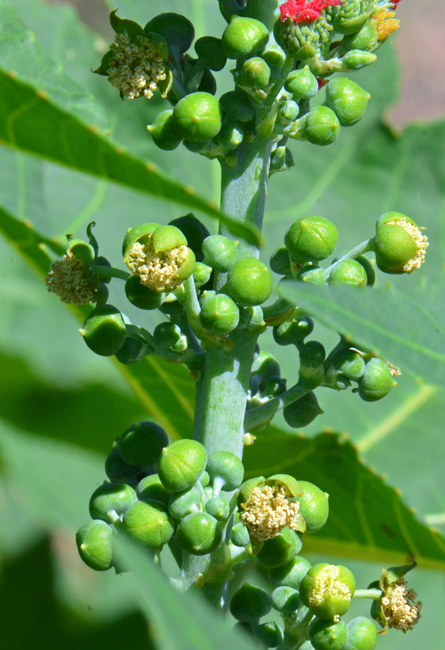
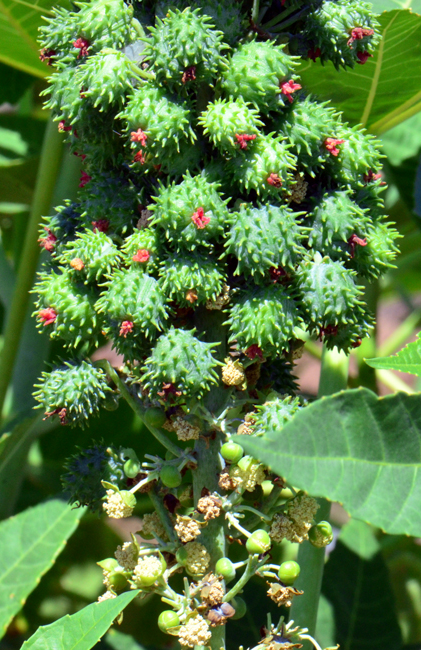

Ricinus communis oil, cold-pressed
Uses
Top topical treatment for osteoarthritis, other joint pain and inflammation
Top treatment for dry eyes and blepharitis
One of the top five plants for hair growth and hair thickening
One of the top plants for constipation, topical or oral
Anxiolytic
For osteoarthritic knee pain
Castor oil was known in Latin as “Oleum Palmae Christi,”¹ literally the oil of the palms or hands of Christ. This likely had to do with the use of castor oil in healing wounds, as well as the shape of the leaf resembling an open hand.
Pliny the Elder, of AD 23 Rome, described the use of castor oil for joints, among other uses.²
In a controlled clinical trial, seniors with knee pain began the trial with an average reported pain level of 7.2 out of ten. They were given topical castor oil, 10 ml to massage on the knees daily, followed by heat application for ten minutes. The control group received neither castor oil nor heat applications. The trial went on for 24 days. The castor oil plus heat group had a 49% improvement in their reported level of pain, whereas the control group had a 7.5% improvement.³
Another study compared the use of topical castor oil to the use of topical heat for joint pain over the course of seven days. Although both treatments were found to be effective, heat reduced pain by 50% in that week, whereas castor oil reduced pain by 57%.⁴
For dry eyes, floaters and blepharitis
Meibomian glands make oil for tears, so that tears don’t evaporate quickly, keeping the surface of the eyes lubricated. A deficiency of this fluid is commonly known as “dry eyes,” formally known as meibomian gland dysfunction.⁵ ⁶
Even very low concentration of castor oil, 2%, along with 5% polyoxyethylene castor oil, was found to be better than saline eyedrops for improving tear function and especially stability of lubrication.
Floaters are loose aggregates of protein in the vitreous, visible as usually faint ripples or shapes or shadows in front of the viewer’s visual field. They result from posterior vitreous detachment of pieces of membrane from the retina. It is a common experience in senior years, as the vitreous becomes less gelatinous and more liquid. Floaters can also be a manifestation of a serious disease, uveitis.
Although many people have reported on social media that floaters disappear after a week to a month of applying castor oil, and dry eyes improve in an even shorter period after topical application of castor oil to closed eyelids, there is almost no information in the medical literature about the value of castor oil for floaters.
Dr. J. Green wrote in the year 1875 about applying a solution of castor oil and atropine sulfate to the inner upper eyelid to successfully treat corneal abrasions and corneal ulcers, as well as phlyctenulae and photophobia.⁷ Atropine sulfate must be used only by experienced physicians, with caution, and under medical supervision.
Blepharitis is an inflammation of the eyelid margin, sometimes with thickening and / or dandruff and / or loss of eyelashes or matting of eyelashes. Pure cold-pressed castor oil was applied to one eyelid twice per day for four weeks in 26 blepharitis patients, while not treating the other eyelid. The treated eye improved in all patients during that time, and without adverse reactions.⁸
For hair growth and prevention of hair loss
When castor oil was combined with rosemary oil, the increase in hair density on mice was greater than other cohorts in which either of those oils were used alone, and showed equivalent effect to the drug minoxidil. The effect was seen to be during the anagen phase.⁹ In a double-blind randomized controlled study in human subjects with a rosemary oil / castor oil combination, hair thickness increased by 66%, and hair density increased by 32% over the course of the 90 days of the study.¹⁰
Two tablespoons of castor oil combined with five drops of rosemary essential oil is a common combination that may be massaged into the scalp and left on for 30 minutes before shampooing. Before that, try a patch test of the mixture the day before on a small area of the inner forearm to check for tolerance. If the patch test is successful, then half-hour to overnight application to the scalp may be used. If the mixture feels too viscous to arrive to the skin of the scalp, it may either be slightly heated to lukewarm, or it may be diluted with a little extra-virgin, cold-pressed olive oil.
For constipation
Dr. Charles Phillips in 1879 described castor oil as “a highly valuable evacuant, also for children . . . and, for infants, it is the safest of cathartics.” He explains: “As a laxative, it operates so speedily and mildly, that it is constantly resorted to where similar operation by medicines of a more powerful nature may cause injury.”¹¹
The ancient Greek physician Dioscorides wrote 2,000 years ago: “Taken as a drink it draws out watery matter through the bowels, and it also draws out worms.”¹²
The Ebers Papyrus of 1534 BC discusses castor oil as a laxative.¹³
For anxiety
At only 0.5 mL/kg, which was 2.5% of the dose of castor oil used as a laxative, male mice showed fewer measures of anxiety-like behavior after injection with castor oil than after injection with saline.¹⁴
Pharmacology and Mechanisms of Action
The U.S. FDA has approved castor oil for ophthalmic, nasal, oral, topical and intramuscular uses.¹⁵ It is classified by the FDA as safe and effective for use as a stimulant laxative. Castor oil is made by cold-pressing the seeds. It does not contain ricin, because the ricin is excluded in the cold-pressing process.¹⁶
In topical use
Castor oil is the pharmacologically active extract in common use from the Ricinus communis plant. As other triglycerides, it has a glycerol backbone and three fatty acid chains. The fatty acids are mostly ricinoleic acid, which is an omega-9 fatty acid, as is oleic acid in olive oil, as well as grapeseed oil. Castor oil is a humectant, meaning a moisture rich substance, and it excels at that role to such a commercially viable extent that its highest reported use concentration (81%) is in lipstick. That is, four-fifths of some lipsticks are castor oil.¹⁷
The ricinoleic acid molecule resembles eicosapentanoic acid of fish oil, which has anti-inflammatory effects. The ricinoleic acid molecule is remarkable for its low molecular weight, which allows it to pass through the epidermis and dermis, and to be absorbed into the circulatory system. This enables castor oil to function as a carrier molecule with substances that accompany it.
For this reason, castor oil must be kept exceptionally clean. Any substance will be carried with it through the skin and into the bloodstream. So it is important to make sure that the castor oil used is “extra virgin,” meaning cold-pressed, and that it is prepared without solvents such as hexane.
For this reason also, castor oil must be stored only in glass. Phthalates as well as bisphenol A (BPA) in plastic can be carried into the body if castor oil has leeched these from a plastic container.
Castor oil’s main mechanisms of action against the sensation of pain are 1) to decrease and to disrupt Substance P pathways, and 2) to bind EP3 prostanoid receptors, which significantly reduces the production of prostaglandin E2.¹⁸ This was a result of ricinoleic acid’s effect as an agonist of EP3 / EP4 receptors.¹⁹ The role of Substance P in pain is to increase glutamate-induced currents in major neurons, and to thus amplify pain, and to sensitize the sufferer to pain,²⁰ even to the point were mild touch can hurt. Capsaicin from cayenne peppers also reduces Substance P, but there is a stinging pain from use of capsaicin, a disadvantage that castor oil does not have. So castor oil, in reducing Substance P and prostaglandin E2, works against both of those pain pathways in a way that is comfortable for the patient. The sensation of castor oil on the skin is often described as soothing.
Castor oil also inhibits prostaglandin D2, which is useful to combat male pattern baldness, also known as androgenic alopecia.²¹ Prostaglandin D2 was found to be more abundant on a bald scalp than on a haired scalp. A study on mice found that prostaglandin D2 had caused miniaturization of hair follicles.²² Castor oil’s effect is to block the synthesis of prostaglandins D2 and E2.
Used topically on eyelids
Castor oil contains monounsaturated fatty acids. From topical application on the eyelids, it is known to deposit into the highly lipophilic retina and uveal tissues, such as the choroid and the ciliary body.²³ Floaters are a manifestation of uveitis, as well as a common condition of aging. These have been treated successfully with castor oil, as therapeutic concentrations of a castor oil based eyedrops were found to arrive to the retina and uveal tissues.²⁴
Taken orally
The way that castor oil functions as a laxative is thought to be as follows: In the small intestine, pancreatic lipase enzymes release ricinoleic acid by hydrolyzing the oil.²⁵ That acid and its salts reduce absorption of water and electrolytes from the intestine. This is one of the main mechanisms of laxatives generally. Then the resulting build-up of fluid inside the small intestine stimulates peristalsis, which stimulates a bowel movement.²⁶ Fluctuations in pH in the small intestine also convert ricinoleic acid reversibly with sodium ricineolate, which induces contraction of the small intestine and the cecum.²⁷
Also, as castor oil activates EP3 receptors on the smooth muscle cells that line the GI tract, propulsive intestinal motility is stimulated.²⁷
If the laxative effect is very thorough or prolonged, then be careful to re-hydrate with water, as well as to replenish food and electrolytes after this process.
Side Effects and Contraindications
The castor bean itself is poisonous, and must never be eaten in any quantity at all, because of the protein ricin, which is a lectin that has been used in chemical warfare. Ricin attaches to the red blood cells and causes them to lyse and to release free hemoglobin, a large protein which in enormous quantity, released from red blood cells, then overwhelms the urinary system, causing hemolytic uremia and then acute renal failure.²⁹ The cascade of damage is thoroughly described.³⁰
The oil that is extracted from the castor bean does not contain the water soluble ricin, and therefore the oil is non-toxic. The oil may be taken internally in moderation. Despite its reputation as a strong laxative, it does not have harsh effect, but rather stimulates peristalsis.
Castor oil taken orally in pregnancy increases prostaglandin E2, in the amniotic cells and placenta.³¹ It has been observed to induce uterine contraction and labor.³² Therefore, it should never be taken earlier in pregnancy than the expected time of delivery. However, when it is taken at term, after premature rupture of membranes, it has been considered a safe and convenient way to induce labor.³³
When castor oil comprised 10% of the diet of rats, no toxic effects were found³⁴ and no growth retardation was observed in weanling rats on that diet.³⁵
Native Origin and Range
Castor is in the Euphorbiaceae family, considered to be from Africa or India, but long naturalized for millennia throughout the world.
-
S Tunaru, T Althoff, et al. Castor oil induces laxation and uterus contraction via ricinoleic acid activating prostaglandin EP3 receptors. May 21 2012. Proc Natl Acad Sci. 109 (23). 9179-9184. https://pmc.ncbi.nlm.nih.gov/articles/PMC3384204/
M Teijeiro. Castor oil: Magic or myth, Part 2. 2019. NDNR. https://ndnr.com/castor-oil-magic-or-myth-part-2
P Rathod, U Vanitha, et al. A study to assess the effectiveness of castor oil massage and hot water application on knee joint pain among elderly patients who are attending the Orthopedic Department at HSK Hospital Bagalkot. Dec 12 2024. https://saspublishers.com/media/articles/SJAMS_131_289-294.pdf
N Chauhan, A Sharma, et al. Comparative study to assess the effectiveness of the hot application and castor oil application in clients with joint pain. Feb 5 2018. Int J Adv Res. 6 (04). 265-270. https://www.journalijar.com/uploads/2018/04/24_IJAR-22721.pdf
K Lindsley, S Matsumara, et al. Interventions for chronic blepharitis. May 16 2012. Cochrane Database Syst Rev. 2012 (5). https://pmc.ncbi.nlm.nih.gov/articles/PMC4270370/
E Goto, J Shimazaki, et al. Low-concentration homogenized castor oil eye drops for noninflamed obstructive meibomian gland dysfunction. Nov 2002. Opthalmology. 109 (11). 2030-2035. https://pubmed.ncbi.nlm.nih.gov/12414410/
J Green. Castor oil as a menstruum for dissolving atropia for application to the eye. 1875. Trans Am Ophthalmol Soc. 2 (355). https://pubmed.ncbi.nlm.nih.gov/25258815/
A Muntz, E Sandford, et al. Randomized trial of topical periocular castor oil treatment for blepharitis. Jan 2021. Ocul Surf. 19. 145-150. https://pubmed.ncbi.nlm.nih.gov/32422285/
A Mathenge, E Odongo, et al. An exploratory preclinical in vivo pilot study evaluating the hair growth-promiting effects of Rosmarinus officinalis and Ricinus communis combination. Biomed Res Int. May 11 2026. 2026:5037275. https://pmc.ncbi.nlm.nih.gov/articles/PMC13159087/
M Patel, N Tuli, et al. Rosmagain as a natural therapeutic for hair regrowth and scalp health: A double0blind, randomized, three-armed, placebo-controlled clinical trial. Jun 13 2025. Cureus. 17 (6). E85906. https://pmc.ncbi.nlm.nih.gov/articles/PMC12256010/
C Phillips. Materia Medica and Therapeutics: Vegetable Kingdom [book]. 1879. New York: William Wood and Company. p. 114.
Dioscorides. De Materia Medica [book, translated to English]. 77 AD. 38.
J Nunn. Ancient Egyptian Medicine [online book] 1996. University of Oklahoma Press. pp. 9, 144. https://archive.org/details/ancientegyptianm0000nunn/
K Nisbett, L Vendruscolo, et al. Indulging curiosity: Preliminary evidence of an anxiolytic-like effect of castor oil and ricinoleic acid. Apr 2024. Nutrients. 16 (10). 1527. https://www.mdpi.com/2072-6643/16/10/1527
U.S. Food and Drug Administration (FDA). Inactive ingredient search for approved drug products. Accessed Sep 5 2026. https://www.accessdata.fda.gov/scripts/cder/iig/index.cfm
American College of Toxicology. Final report on the safety assessment of Ricinus communis (Castor) seed oil, hydrogenated castor oil, glyceryl ricinoleate, glyceryl ricinoleate SE, ricinoleic acid, potassium ricinoleate, sodium ricinoleate, zinc ricinoleate, cetyl ricinoleate, ethyl ricinoleate, glycol ricinoleate, isopropyl ricinoleate, methyl ricinoleate, and octyl dodecyl ricinoleate. May 2007. Int J Toxicol. 3. 31-77. https://pubmed.ncbi.nlm.nih.gov/18080873/
American College of Toxicology. Ibid.
S Boddu, H Alsaab, et al. Anti-inflammatory effects of a novel ricinoleic acid poloxamer gel system for transdermal delivery. Feb 1 2015. Int J Pharm. 479 (1). 207-211. https://pubmed.ncbi.nlm.nih.gov/25542985/
S Tunaru, T Althoff, et al. Castor oil induces laxation and uterus contraction via ricinoleic acid activating prostaglandin EP3 receptors. May 21 2012. PNAS. https://www.pnas.org/doi/full/10.1073/pnas.1201627109
C Humes, A Sic, et al. Substance P’s impact on chronic pain and psychiatric conditions – A narrative review. May 28 2024. Int J Mol Sci. 25 (11). 5905. https://pmc.ncbi.nlm.nih.gov/articles/PMC11172719/
K Girdler, A Cabatu, et al. Use of castor oil in dermatology: A narrative review. Feb 9 2026. Cureus. 18 (2). https://pmc.ncbi.nlm.nih.gov/articles/PMC12978418/
P Fong, H Tong, et al. Dec 4 2015. In silico prediction of prostaglandin D2 synthase inhibitor from herbal constituents for the treatment of hair loss. J Ethnopharmacol. 175. 470-480. https://www.sciencedirect.com/science/article/abs/pii/S0378874115301677?via%3Dihub
A Mandal, K Cholkar, et al. Topical formulation of self-assembled antiviral prodrug nanomicelles for targeted retinal delivery. May 4 2017. Mol Pharmaceutics. 14 (6). 2056-2069. https://pubs.acs.org/mpohbp/article-abstract/14/6/2056/679637/Topical-Formulation-of-Self-Assembled-Antiviral
K Cholkar, B Gilger, et al. Topical, aqueous, clear cyclosporine formulation design for anterior and posterior ocular delivery. May 2015. Transl Vis Sci Technol. 4 (3). 1. https://pmc.ncbi.nlm.nih.gov/articles/PMC4418434/
S Tunaru, T Althoff, et al. Castor oil induces laxation and uterus contraction via ricinoleic acid activating prostaglandin EP3 receptors. May 21 2012. Proc Natl Acad Sci. 109 (23). 9179-9184. https://pmc.ncbi.nlm.nih.gov/articles/PMC3384204/
D Hoffman. Medical Herbalism [book]. 2003. Rochester VT: Healing Arts Press. 266.
I Iwao, Y Terada. On the mechanism of diarrhea due to castor oil. Jun 30 1962. Japanese J Pharmacol. 12. 137-145. https://pdf.sciencedirectassets.com/321778/1-s2.0-S0021519862X12029/1-s2.0-S0021519819645154/main.pdf
Tunaru, Ibid.
V Korcheva, J Wong, et al. Administration of ricin induces a severe inflammatory response via nonredundant stimulation of ERK, JNK and P38 MAPK and provides a mouse model of hemolytic uremic syndrome. Jan 2005. Am J Pathol. 166 (1). 323-339. https://pmc.ncbi.nlm.nih.gov/articles/PMC1602309/
J Wong, V Korcheva, et al. Intrapulmonary delivery of ricin at high dosage triggers a systemic inflammatory response and glomerular damage. May 2007. Am J Pathol. 170 (5). 1497-1510. https://pmc.ncbi.nlm.nih.gov/articles/PMC1854946/
J Gao, N Sun, et al. Effects of castor oil diet on the synthesis of prostaglandin E2 in pregnant rats; [transl from Chinese]. Mar 1999. Zhongua Fu Chan Ke Za Zhi. 34 (3). 147-149. https://pubmed.ncbi.nlm.nih.gov/11263183/
Tunaru, Ibid.
L Davis. The use of castor oil to stimulate labor in patients with premature rupture of membranes. Nov Dec 1984. J Nurse-Midwifery. 29 (6). https://www.sciencedirect.com/science/article/abs/pii/0091218284901666?via%3Dihub
American College of Toxicology. Final report on the safety assessment of Ricinus communis (Castor) seed oil, hydrogenated castor oil, glyceryl ricinoleate, glyceryl ricinoleate SE, ricinoleic acid, potassium ricinoleate, sodium ricinoleate, zinc ricinoleate, cetyl ricinoleate, ethyl ricinoleate, glycol ricinoleate, isopropyl ricinoleate, methyl ricinoleate, and octyl dodecyl ricinoleate. May 2007. Int J Toxicol. 3. 31-77. https://pubmed.ncbi.nlm.nih.gov/18080873/
M Ihara-Watanabe, T Shiroyama, et al. Effects of castor oil on lipid metabolism in rats. Jan 1 1999. Biosci, Biotech and Biochem. 63 (3). https://academic.oup.com/bbb/article-abstract/63/3/595/5946688?redirectedFrom=fulltext
