
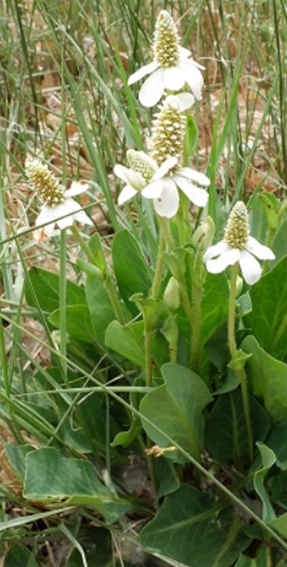
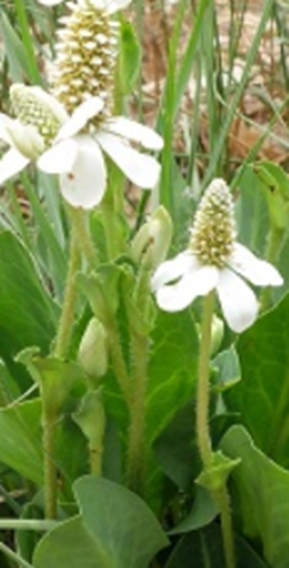
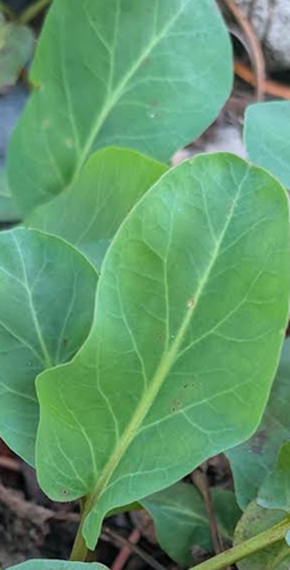
Yerba mansa blossoms photo from https://rockymountainsflora.com Wildflowers of the Southwest
Anemopsis californica, aka Houttuynia californica roots
Uses
One of the top five herbs for bronchitis and pneumonia; helpful for respiratory congestion from the sinuses through the lungs
It is thought to lower uric acid in gout
Stroke recovery
Anti-proliferative activity against uterine, endometrial and cervical cancer cells
Wound care, and effects against skin aging
To best understand the effects of Yerba mansa in humans, let’s first explore its role in its natural habitat, which are the relatively rare wet, marshy, spring-fed bogs and waterlogged areas and alkaline meadows and floodplains in the otherwise mostly dry Sonoran Desert of the southwestern United States and northwestern Mexico. Its Spanish name, Yerba mansa, likely derives from hierba remanso, meaning herb from backwaters.¹
Herbalist Dara Saville writes: “In the wild, [Yerba mansa] regulates the movement of waters carrying oxygen and nutrients through the land while aerating the soil and invigorating the wet, boggy, slow-moving environment.”² However, pollutants can also be carried by Yerba mansa, in its role as an environmental filter in wetlands. Herbalists view Yerba mansa’s historical uses as analogous to its environmental role: Indigenous populations have used it to promote sweating, emetic and laxative uses.³
For bronchitis and pneumonia
People of the Kawaiisu and the Tubatulabal tribes traditionally boil Yerba mansa roots to create a decoction, which is consumed while hot to treat colds and coughs. The Pima also used a Yerba mansa root decoction for coughs. The Cahuilla people have used it to treat pleurisy. Indeed, the breadth of use of Yerba mansa across the indigenous peoples in and near the Sonoran Desert of the southwest US and Mexico is impressive. Chumash, Diné (The Navajo Nation), Pueblo, Tewa, Isleta, Acoma, Laguna, Paieute, Shoshone, Washoe, Adimel O’odham (Pima), Cahuilla, Ohlone (Costanoan, Kawaiisu Tubatulabl and Comcaac (Seri) people all have recorded consistent uses of this essential herb.⁴
Yerba mansa excels at expectoration of thick mucus from congested areas of the respiratory tract and other mucous membranes. From the sinuses and the nose down through the throat and even the lungs, Yerba mansa has a very useful combination of expectorant, astringent, anti-inflammatory, antioxidant and antimicrobial properties. Herbalist Michael Moore writes, “[Yerba mansa] stimulates better fluid transport, helping to remove the exudates that prevent repair of the irritation that began the whole mess.”⁵
For lowering uric acid in gout
Gout is a condition of urate not being eliminated adequately by the kidneys, and then monosodium urate crystal deposition in the tissues, most painfully and noticeably at a joint, such as the weight-bearing big toe. Gout affects six times as many men as women, which seems to trace to women’s higher fractional excretion of urate. Gout is on the rise throughout the world. The deposit of uric acid crystals, commonly in the 1st toe, less commonly in the knee and other joints creates intense focal inflammation and resulting pain. Cardiovascular effects of increased uric acid include plaque formation in a linear correlation, p = 0.002.⁶ Those who suffer from gout have been seen to excrete less urate as a proportion of uric acid, which implies that gout patients retain urate.
Hyperuricemia, high uric acid in the blood, results from either increased production of uric acid or underexcretion of it. Gout and rheumatoid arthritis have been associated with high uric acid, as well as other conditions such as kidney stones and other kidney conditions, hypertension and cardiovascular disease, as well as metabolic syndrome and diabetes.
Herbalist Michael Moore claimed that Yerba mansa decreases uric acid in the blood by way of diuresis, an idea to be explored below in the Pharmacology section.⁷
Effects against gynecological cancers
An essential oil of Yerba mansa inhibited the growth of uterine and cervical cancer cell lines in vitro, at only 0.056% and 0.052% concentrations respectively. These were far more potent effects than any of the chemical constituents of Yerba mansa tested separately against those cancer cell lines. Interestingly, of all the indigenous populations studied that used Yerba mansa medicinally, there was consistency in its use specifically against uterine and other gynecological cancers.⁸
Skin aging
The aging of skin is often seen in wrinkles, dryness and discolored spots. An extract of Yerba mansa in a skin cell culture caused a decline of inflammatory cytokines IL-1β, IL-6 and TNF-α, by 74%, 79% and 43% respectively. Yerba mansa was also seen to preserve collagen.⁹
Pharmacology and Mechanisms of Action
Herbalist Michael Moore claimed that Yerba mansa decreases uric acid in the blood by way of diuresis, specifically of nitrogenous acids.¹⁰ However, we have not yet seen specific evidence of this action in the medical literature. Rather, it is possible that the effect of lowering uric acid in the blood may result from general diuretic effect, by a generally increased volume of urine output that inevitably dilutes and flushes solutes out of the system.
Humans as well as the great apes have lost along our extensive history the gene that encodes the uricase enzyme, which oxidizes uric acid to a safer compound, allantoin. As a result, humans have seven times the uric acid of other mammals.¹¹ This is one of those historical developments that can be seen as either a blessing or a curse, or, more likely, a subsequent adaptation to an earlier adaptation. That is, humans lost the ability, during our long history, that other mammals retain, to synthesize vitamin C.¹² So with that loss, we needed a different strong antioxidant. Uric acid is one of the strongest antioxidants in the body, as much so as vitamin C. So, over the history of human development, we then needed a way to keep it in the blood longer, not immediately converted to a less useful molecule. Hence, over time we lost uricase. The downside is that when too much uric acid accumulates, then we run the risk of flooding the pathways below, shown by So and Thorens in: https://pmc.ncbi.nlm.nih.gov/articles/PMC2877959/ :
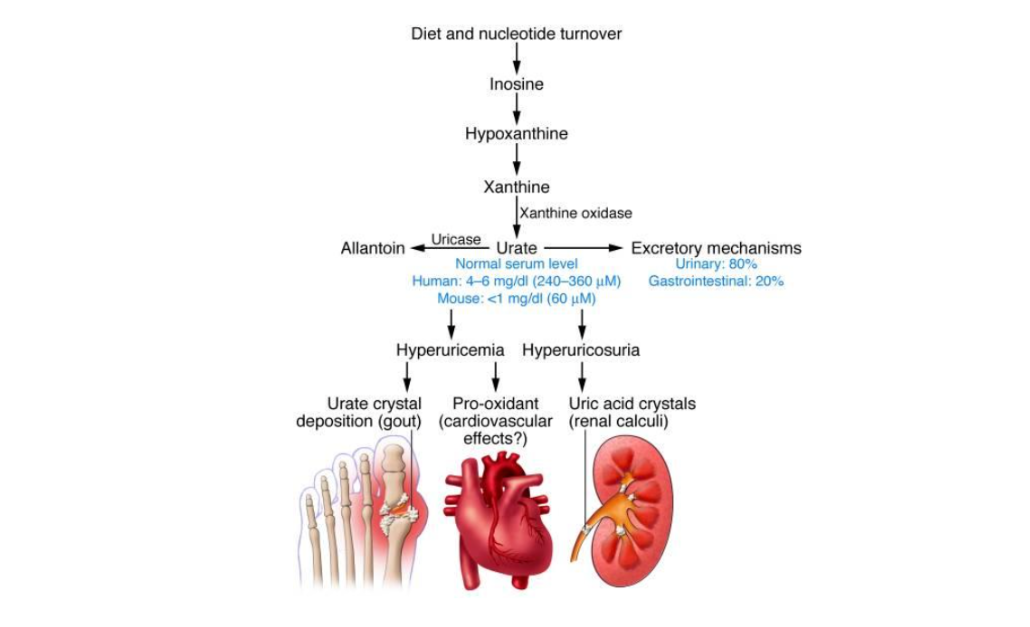
Also, there is a pro-oxidant aspect to uric acid, which increases oxidation of already oxidized LDL molecules.
By promoting the flow of urine (diuresis), Yerba mansa helps the kidneys to filter and to flush out accumulation of uric acid in the blood before it can crystallize in the joints, as in gout, or to form painful kidney stones.
However, caution must be taken, because diuresis can cause lower renal excretion of urate, and this can result in increased uric acid, by means of diuretic-induced hyperuricemia. Generally, diuretics do this because they cause salt and water loss, which leave more of other solutes, such as uric acid, more concentrated in the remaining blood.¹³ Although diuretics flush more fluid, which flushes more solutes, it leaves behind a lower volume of blood, which triggers a compensatory increase in the reabsorption of water, salts and urate, to boost blood volume. This increased urate concentration is undesirable for its association with gout.
The most commonly prescribed diuretic in the U.S., hydrochlorothiazide (HCTZ) has this risk because it competes with urate for secretion into the renal tubule, which has the result of leaving more urate behind in the blood. The loop diuretics have even higher risk for developing gout.¹⁴
A complicating factor to the implication of diuretics in gout is that those drugs are often prescribed for people with heart failure or hypertension, which are both already correlated with poor clearance of urate, and therefore gout risk.¹⁵
Citrus and coffee do not have that effect. In the case of citrus, that is because, the release of bicarbonate atoms from metabolized citrus alkalinizes blood and urine, which allows the kidneys to flush out urate more easily.
And coffee does not have that effect, although it is likely the world’s most commonly and casually used diuretic. But it does not increase urate stores in the body, because it has polyphenols that compete with and inhibit the precursor to uric acid, namely xanthine oxidase. Both coffee and citrus decrease the production of urate and inhibit its reabsorption. The net result is urate clearance.
Similarly, Yerba mansa root contains abundant polyphenols such as tannins. It may be the case that the polyphenols of Yerba mansa are the competitors of xanthine oxidase that help prevent gout. But that specific statement does not yet have support in the medical literature. Rather Yerba mansa’s effect against xanthine oxidase, and thus uric acid accumulation, may be attributed to its anti-inflammatory properties. Those antioxidants include the phenylpropanoids methyleugenol and elemicin as well as the monoterpenoids thymol and piperitone.
Methyleugenol comprises 55% to 59% of the oil of Yerba mansa root, which is toward the higher end in Yerba mansa plants from lower elevation and warmer areas. In colder and higher elevations, elemicin and piperitone and thymol were of higher proportion.¹⁶
The anti-inflammatory properties of methyleugenol are likely due, in most part, to its ability to scavenge free radicals. In ischemic stroke patients, this effect was found to significantly reduce reactive oxygen species in affected cells. Methyleugenol significantly reduced mRNA expression of pro-inflammatory cytokines, including IL-1β, IL-6 and TNF-α. Methyleugenol simultaneously increased mRNA expression of anti-inflammatory cytokines IL-10 and TGF-β.¹⁷ Inflammation and oxidative stress are some of the most devastating obstacles to recovery from ischemic stroke, including during reperfusion of previously deprived tissues,¹⁸ and Yerba mansa was shown to help resolve each of these issues.
Effects of Yerba mansa against bronchitis and pneumonia are likely attributable to several mechanisms:
Expectorant, astringent and antimicrobial properties are a powerful synergy against a mucous-clogged respiratory tract. In a study of anti-microbial constituents of Yerba mansa, α-pinene was found to most strongly inhibit Staphylococcus aureus, but essential oil of Yerba mansa leaf was found to be the most effective for that purpose, as well as in 0.1% concentration against Strep. Pneumoniae, and Geotrichim candidum.¹⁹
In addition, with the suppression of pro-inflammatory cytokines shown above, the respiratory tract benefits from anti-inflammatory, anti-oxidant, astringent and anti-bacterial effect of two of the most common pneumonia pathogens.
Side Effects and Contraindications
Yerba mansa grows in marshy areas, and is therefore vulnerable to water pollution, particularly heavy metal accumulation in contaminated groundwater. Thus, it filters some of those contaminants from the waters that flow past and surround it. This serves as an environmental caution to those of us who would gather from congested or agricultural or industrial areas, preferring instead organic and or remote harvesting.
As with all herbs and products derived from herbs and dosing, we strongly recommend working with an experienced naturopathic physician or herbalist, especially in pregnancy, breastfeeding and for infants and children.
Native Origin and Range
Yerba mansa is in the Saururaceae family. Throughout its Sonoran Desert range, it has been used medicinally by each indigenous tribe and Latino community in that region.²⁰
-
L Vasconcellos. Yerba mansa. Friend of Los Peñasquitos Canyon Preserve. https://www.penasquitos.org/news/yerba-mansa
D Saville. Anemopsis californica (yerba mansa) monograph. Spring 2020. J Am Herbalists Guild. 18 (1). https://yerbamansaproject.org/wp-content/uploads/2021/03/Anemopsis-californica-monograph.pdf
F Ellingwood, J Lloyd. American Materia Medica, Therapeutics and Pharmacognosy [book]. 1915. Chicago: Ellingwood's Therapeutist.
Herbal Reality. Yerba mansa; Anemopsis californica. Jul 24 2026. https://www.herbalreality.com/herb/yerba-mansa/
M Moore. Medicinal Plants of the Desert and Canyon West [book]. 1989. p. 134.
T Neogi, R Ellison, et al. Serum uric acid is associated with carotid plaques: The National Heart, Lung and Blood Institute Family Heart Study. Feb 2009. J Rheumatol. 36 (2). 378-384. https://pmc.ncbi.nlm.nih.gov/articles/PMC2731484/
M Moore. Medicinal Plants of the Desert and Canyon West [book]. 1989. p. 134.
A Medina-Holguín, F Holguín, et al. Chemotypic variation of essential oils in the medicinal plant, Anemopsis californica. Jan 4 2009. Phytochemistry. 69 (4). 919-927. https://pmc.ncbi.nlm.nih.gov/articles/PMC2330197/
Q Nguyen, M Fang, et al. Anemopsis californica attenuates photoaging by regulating MAPK, NRF-2 and NFATc1 signaling pathways. Nov 25 2021. Antioxidants (Basel). 10 (12). 1882. https://pmc.ncbi.nlm.nih.gov/articles/PMC8698643/
M Moore. Ibid.
A So, B Thorens. Uric acid transport and disease. Jun 1 2010. 120 (6). J Clin Invest. 1791-1799. https://pmc.ncbi.nlm.nih.gov/articles/PMC2877959/
B Ames, R Cathcart, et al. Uric acid provides an antioxidant defense in humans against oxidant- and radical-caused aging and cancer: a hypothesis. Nov 1981. Proc Natl Acad Sci. 78 (11). 6858-6862. https://pmc.ncbi.nlm.nih.gov/articles/PMC349151/
E Pascual, M Perdiguero. Gout, diuretics and the kidney. Aug 2006. Ann Rheum Dis. 65 (8). 981-982. https://pmc.ncbi.nlm.nih.gov/articles/PMC1798242/
P Waller, L Ramsay. Predicting acute gout in diuretic-treated hypertensive patients. Dec 1989. J Hum Hypertens. 3 (6). 457-461. https://pubmed.ncbi.nlm.nih.gov/2607519/
J Scott, C Higgens. Diuretic induced gout: a multifactorial condition. Feb 1992. Ann Rheum Dis. 51 (2). 259-261. https://pmc.ncbi.nlm.nih.gov/articles/PMC1005670/?page=1
A Medina-Holguín, F Holguín, et al. Chemotypic variation of essential oils in the medicinal plant, Anemopsis californica. Jan 4 2009. Phytochemistry. 69 (4). 919-927. https://pmc.ncbi.nlm.nih.gov/articles/PMC2330197/
Y Choi, G Cho, et al. Methyleugenol reduces cerebral ischemic injury by suppression of oxidative injury and inflammation. Jan 5 2010. Free Radical Res. 44 (8). 925-935. https://doi.org/10.3109/10715762.2010.490837
C Behl, B Moosmann. Oxidative nerve cell death in Alzheimer's Disease and stroke: Antioxidants as neuroprotective compounds. Mar-Apr 2002. Biol Chem. 383. 521-536. https://doi.org/10.1515/bc.2002.053
A Medina, M Lucero, et al. Composition and antimicrobial activity of Anemopsis californica leaf oil. 2005. J Agric Food Chem. 53. 8694-8698. doi: 10.1021/jf0511244
L Curtin. Healing Herbs of the Upper Rio Grande [book]. 1965. Los Angeles: Southwest Museum. Cited in D Saville. Anemopsis californica (yerba mansa) monograph. Spring 2020. J Am Herbalists Guild. 18 (1). https://yerbamansaproject.org/wp-content/uploads/2021/03/Anemopsis-californica-monograph.pdf
