
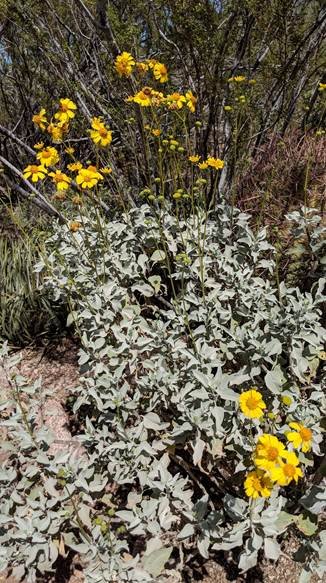
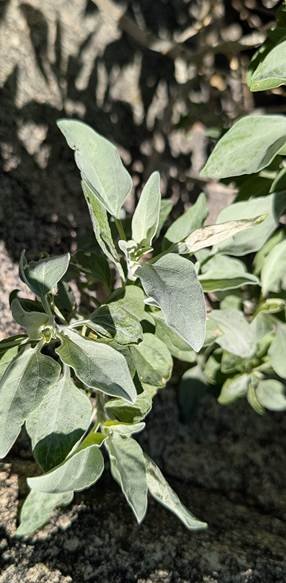
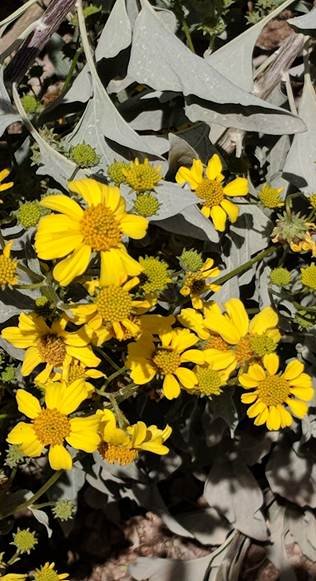
Encelia farinosa, leaves, stems and gum
Uses
One of the top herbs for a vaporous decongesting rub, applied to the chest during a cold
For dry eyes
Toothaches and loose teeth
For inflammation generally
This common plant of the Sonoran Desert has ubiquitous, striking and tall flowers, often standing way above its nearly hemispherical bush of fuzzy, fragrant, grey-green leaves. In the spring its bright yellow daisy-like flowers cannot be missed, and has been seen by all when traveling through this desert.
For chest colds and congestion
The gum or sap is used to prepare a chest rub that has been helpful to decongest a chest cold. Preparation is as follows.
We prefer to start with a wide mouth jar that will not need to be reused. Place a thick layer of lard or beef tallow, or for the vegans among us, coconut oil in the bottom of the jar to cover the bottom of it, perhaps two tablespoonsful or so. Carry the jar over to the stems of the Brittlebush, and cut the brittle stems – hence the name - close to the roots. The translucent yellow sap will ooze freely, and it is extremely sticky and hard to remove.
Stick the cut ends down into the jar, so each end is sitting on top of the fat. Let the gum ooze onto the fat, and after the stems have given up their medicine, use a disposable plastic spoon or other non-essential spoon to mix the gum with the fat to make the rub. The rub may be refrigerated until needed for a decongesting chest rub. Watch out for hard to wash stickiness of the sap, as discussed under Side Effects. In fact, the gummy sap is so gluey that it was used to fasten arrowheads to arrow twigs, and it was even useful to waterproof the inside surface of water vessels. The fragrant gum is so pleasant smelling that it has long been used as incense in churches throughout the Baja peninsula.¹
For dry eyes
Herbalist John Slattery writes of regular oral use of Brittlebush tincture to “gradually restore proper lubrication to dry eyes.”² One to two droppersful taken by mouth two times per day for at least two months has helped with this problem. It is not recommended to place any substance at all in the eyes, unless prepared by a naturopathic physician or an herbalist. Slattery also writes that Brittlebush is also a calming nervine, so it can be taken morning and evening without excess stimulation, while, like the herb Kava, it enhances alert focus while being calming.
We have seen no discussion of these latter properties in the medical literature. But that of course is no good reason for dismissal, as the age of PubMed is a mere fraction of the many centuries of human use of botanical medicine, and the oral traditions that inform future generations of what has worked for our distant ancestors has maintained consistency across time and across tribes and even continents.
For loose or aching teeth
The Seri people had a tradition of “hardening” a loose tooth by taking a thick Brittlebush stem and removing the bark. A branch was heated and placed against a painful tooth or a loose tooth.³
Pharmacology and Mechanisms of Action
It is possible that the effects of Brittlebush on teeth and as a chest rub are partly due to the simple mechanical property of the stickiness of the gum holding the most helpful molecules where they are needed, and long enough to do the job.
Brittlebush phytochemicals include its monoterpenes, sesquiterpenes and sesquiterpene lactones.
Sesquiterpene lactones are a diverse group of plant chemicals that have in common a 15-carbon structure. They have shown various biological activities that are beneficial, particularly regarding their anti-inflammatory role.⁴ In molecules of sesquiterpene lactones, the lactone ring seems to be the main site of metabolism.⁵ Sesquiterpene lactones have potent anti-inflammatory and antioxidant effects. They been found to reduce lipid peroxidation in the liver.⁶ This class of biochemical has been found to decrease inflammation in several ways: 1) By inhibiting the master regulator of the inflammatory cascade, namely NF-κB, (nuclear factor-kappa B); 2) as an obstacle to the release of neutrophils to an inflamed area; 3) by blocking release of the pro-inflammatory cytokine TNF-α, by activating: 4) superoxide dismutase and 5) catalase.⁷ Also, sesquiterpene lactones reduce uric acid levels in the blood, hyperuricemia, which is the main cause of the inflammatory condition known as gout.⁸
The way in which sesquiterpenes fight NF-κB-induced inflammation is that they alkylate key cysteine residues. That begins a process that in turn blocks NF-κB from entering the cell nucleus to turn on inflammatory genes.⁹
As a result of that obstacle to inflammatory gene activation, we have a number of useful benefits. As mentioned above, inflammatory cytokines are decreased. Those include TNF-α, IL-1β and IL-8. Other inflammatory molecules are also decreased by knocking out NF-κB activity: We also benefit from reduction of inducible nitric oxide synthase (iNOS), Cyclooxygenase-2 (COX-2) and prostaglandin E2 (PGE2).
What is inflammation?
First, let’s examine what inflammation does in the body. Inflammation is a necessary bodily function for healing. However, the stimulus for that process is a flesh wound or an infection, and the problem with those is that they are unforeseeable and unpredictable in their locations, depths, range throughout the body, or early and late effects. Therefore, the immune system cannot possibly be specifically and finely tuned to the exact parameters of an assault in advance, to be able to handle the variables of an unforeseeable injury. So then, from the time of the assault, we have the means to launch the necessary upheaval of mobilization of immune resources and battalions of white blood cells rushing to resolve and correct the imbalance. In that process, there is the upheaval - heat, swelling, redness and pain - that so much cell-level warfare entails. So the process is not neat and quick, and neither is the reversal of it.
“It is a crucial process but can become detrimental when it occurs in excess due to its tissue-damaging potential since several types of unspecific effector molecules are released, causing collateral damage. In the case of transitory abnormal conditions, an acute inflammatory response successfully restores the system’s basal homeostatic setpoints after pathogen clearance or tissue repair. However, if the inflammatory trigger persists, the ongoing inflammatory state shifts the system to different setpoints, and acute inflammation may progress to chronic inflammation and, ultimately, disease.¹⁰”
As vulnerable as a mobile creature is to unwanted infections and flesh wounds, the immobile part of the living world, namely the plant kingdom, is so much more vulnerable, as plants can only use and benefit from one half of ‘fight or flight’ in the face of some antagonist, which leaves plants to resort to their considerable biochemical arsenal.
And the plant kingdom is older than we are. Plants have their ancestral roots in algae, dating to over a billion years old. Therefore, it is not surprising that plants developed sesquiterpenes and sesquiterpene lactones for the own healing and benefit. We are fortunate for the plant kingdom’s bounty of helpful molecules.
Side Effects and Contraindications
Herbalist Michael Moore claimed that the gum of Brittlebush is so viscous and sticky that it “can only be removed from utensils, flesh and clothing by sand blasting or a discreet, “clean” thermonuclear device,”¹¹ and one should interpret Moore’s cautionary warnings in view of the humor with which he taught herbal lore during his lifetime. Nevertheless, the herb gatherer should be forewarned of the inconvenience of collecting the gluey, oozing gum.
The inexperienced reader should take the information in this article with caution. Brittlebush gum is extremely sticky, and it is very hard to work with.
Native Origin and Range
Brittlebush is in the Compositae family. Brittlebush blossoms, as a ubiquitous yellow blanket over the desert, have been seen by everyone driving, biking or hiking in springtime through the Sonoran Desert, central and southwestern Arizona, southeastern California and northwest Mexico and Baja California, below 3,000 feet elevation. These vivid yellow flowers are especially abundant after an El Niño winter of rainfall.
-
E Ayensu. Encelia. 2004-2022. All about incense, oils and aromatics. https://incensemaking.com/aromatics/encelia/
J Slattery. Southwest Medicinal Plants [book]. 2020. New York: Timber Press. p. 93.
J Soule. Brittlebush has bunches of uses. Mar 29 2023. Savor the Southwest. https://savorthesouthwest.net/brittlebush-has-bunches-of-uses/
M Matos, J Anastácio, et al. Sesquiterpene lactones: Promising natural compounds to fight inflammation. Jun 30 2021. Pharmaceutics. 13 (7). 991. https://pmc.ncbi.nlm.nih.gov/articles/PMC8309091/
M Grafakou, C Bardda, et al. Study on the metabolism of natural sesquiterpene lactones in human liver microsomes using LC-Q-TOF-MS/MS. Jun 2024. Nat Prod Res. 38 (11). 1855-1863. https://pubmed.ncbi.nlm.nih.gov/37354443/
A Mahesh, R Jeyachandran, et al. Jun 2010. Hepatocurative potential of sesquiterpene lactones of Taraxacum officinale on carbon tetrachloride induced liver toxicity in mice. Acta Biol Hung. 61 (2). 175-190. https://pubmed.ncbi.nlm.nih.gov/20519172/
A Fernandes, R Cunha, et al. Sesquiterpene lactones from Lychnophora species: Antinociceptive, anti-inflammatory, and antioxidant pathways to treat acute gout. Apr 6 2021. J Ethnopharm. 269. https://www.sciencedirect.com/science/article/pii/S0378874120336266
A Fernandes, G Coelho, et al. In vivo anti-hyperuricemic activity of sesquiterpene lactones from Lychnophora species. Jul 4 2018. Braz J Pharmacognosy. 29. 241-245. https://pdf.sciencedirectassets.com/306147/1-s2.0-S0102695X19X00034/1-s2.0-S0102695X1830334X/main.pdf
I Merfort. Perspective on sesquiterpene lactones in inflammation and cancer. 2011. Current Drug Targets. 12. 1560-1573. https://doi.org/10.2174/138945011798109437
M Matos, J Anastácio, et al. Sesquiterpene lactones: Promising natural compounds to fight inflammation. Jun 30 2021. Pharmaceutics. 13 (7). 991. https://pmc.ncbi.nlm.nih.gov/articles/PMC8309091/
M Moore. Medicinal Plants of the Desert and Canyon West [book]. 1989. p. 52.
